
SCI at Hollyhock – A Model in Leadership for Our Time

What attracted me to attend Social Change Institute (SCI) 2012 at Hollyhock, British Columbia, was the opportunity to be within a circle of like-minded professionals, business people, organizations, as well as visual and performing artists, who share the same intentionality in our respective pursuits – co-creating a better world that inclusively benefits the human family and planetary well-being.

The first aspect of SCI’s uniqueness is the phenomenon of such a gathering of multi-faceted knowledge, experience and talent – across sectors – to learn together and collaborate.

For different sectors seldom come together to exchange knowledge and make the effort to understand each other’s contributions more fully, particularly to address the bigger picture of improving the quality of life for all. Even within a single sector or, indeed, single organization – individuals’ conflicting priorities and a focus on short term needs, can short circuit larger long term possibilities.

Regardless, I believe the imperative question of this historic moment, for each and every human being is: “Which story are you caught in?” Here I repeat a quote by visionary philosopher Jean Houston, whom I cited in my previous blog.

In other words, are we holding on for dear life to the story that is familiar to us, namely, practicing the same professional and personal practices and habits in the illusion of security, even as the natural environment and climate exhibit radical changes, and the economic base is crumbling under us, evident most obviously in increasing job losses and growing nation state crises?

The significance of Hollyhock’s SCI, and its affiliated institutes, is that the participants pro-actively want to write a new story. This story is not linear, yet instead circular, to take humanity on a life-affirming, spiral journey of page-turning planetary possibilities.

Some folks already have become the characters of the beginning chapters of this new story, experientially living and manifesting it, modelling what is possible in this moment’s planetary project. These folks are from all generations.

In fact, an SCI `intergenerational’ dialogue one evening offered a safe space for everyone to voice the widespread problem in getting jobs and their mixed experiences with other generations. The dialogue circles were healing and unifying. For everyone had a story of feeling discriminated against because of age, regardless of how young or how old each of us happens to be.

Participants also challenged the negativity of mainstream news stories which tend to pit different generations against each other. One future task became self-evident, the need to encourage or initiate group and community dialogues wherever we live, to discuss ways to value and apply the skills and wisdom of all generations.

Judy Rebick, veteran activist, and host of the `intergenerational’ opening presentation titled The Art of Social Change Leadership, introduced a wonderful example of working across generations, documented in her latest book Occupy This!

Tzeporah Berman also numbered among the several inspiring keynote speakers. In a morning presentation, she regaled the SCI participants with tales from the days of the  Clayoquot Sound protest and being imprisoned, among other anecdotes from her recent book This Crazy Time, Living Our Environmental Challenge.

Silas Balabyekkubo is a hip hop artist and co-founder of Luba Flow, a positive form of hip hop in Uganda. He brought tears to our eyes through the gentle love that he expressed, singing about why and how the lives of the children of Uganda can be transformed. He is dedicated to that pursuit. I will speak more about Silas in my next blog.

What impressed me overall at SCI was the emphasis on what is possible. In that engagement, we rose above the common human tendency to spin our wheels in repeating what is wrong with the world, and getting stuck deeper in the mud of self-induced powerlessness.

In the yin-yang of life, however, we cannot ignore the perceived obstacles, but instead need to recognize and name them clearly. Next, the more difficult work essential for making change requires us to shore up courage, integrity and our other higher qualities, to help us move past the inevitable resistance of human nature to change.

The second aspect of the SCI’s uniqueness, in that spirit, was its holistic approach to professional, and more specifically, leadership development. For five days, change makers in social justice and environmental advocacy and activism came together to shore up each other, and also be nurtured and reinforced by advisors and supporters who recognize the mental, emotional, physical and spiritual toll of doing this work.

Too often – and I know from life long experience – choosing to work towards a bigger vision can be lonely and disheartening, even crushing, when surrounded by so many people either indifferent in the cocoon of their own comfort or shut down from fear, despair, bereft of vision, feeling overwhelmed just to get from one day to the next.

At the opening morning focus forum, guest speaker Gibran Rivera set the holistic tone for the SCI experience by inviting the inclusion of the soul. True to an authentic spiritual way of offering something to reflect upon, in his follow up role to begin the evening sessions, he raised heartfelt questions for us to explore, such as: What brings you joy? What are you seeking?

The range of SCI participatory interactions, from serious to playful, addressed the strengthening of both outer and inner capabilities of each respective participant, whether an emerging or veteran change maker. In this way, the SCI demonstrated the mandate of Hollyhock, as `Canada’s Lifelong Learning Centre’: “to inspire, nourish and support people making the world better.”

The SCI program, first of all, included a diversity of skill-building workshops, focus forums, and one-on-one sessions, in which participants received hard-nosed, practical advice about effective strategies, financial accountability, and how to achieve clearly identifiable goals.

As an example of a `focus forum,’ on each of three mornings, a case study of a nonprofit organization was examined (after a presentation by its founder), based on its good work to date and how to move it forward. Selected 2012 organizations included Shark Truth, 350.org, and the British Columbia Civil Liberties Association.

Also integral to the SCI’s holistic approach were: the inclusion of pre-breakfast very early morning meditation and yoga; free choice to take time out through the day for private moments in the Sanctuary and/or going for walks on the beach or in the woods; and evening sessions that included dialogue circles and experiential exercises to explore our inner emotional and spiritual condition in a respectful atmosphere. Later evening music and dancing was optional for anyone who still had the energy.

Something extraordinary happens when people choose to bring all of who they are to be present in a compassionate circle of fellow human beings. I believe it was the photographer Andre Kertesz who once said: “The eyes are the windows to the soul.”

In safe spaces of intimate conversation, when people make eye contact and totally pay attention to another human being, it is a beautiful gift. For the sad reality felt by many people in our troubled world is that the soul very often is not welcomed. Indeed, we witness the consequences of a neglected soul so painfully evident in mental health problems, addictions and other misguided acts of destruction.

The third aspect of SCI’s uniqueness speaks to the present moment of technological obsession in the larger society. A growing number of people are so attached to their communication gadgets that these inanimate objects become 24/7 virtual appendages.

How refreshing, throughout the SCI, to experience a non-beeping environment, and instead immerse oneself in the joy and power of personal encounters in which our innate skills such as `active listening’ could be awakened.

A computer lab was available at SCI and participants could use their own gadgets, privately. But, in the sessions, mobile technologies were blessedly absent, in order to give full attention and respect to the processes. Discussion about the creative and valuable strategies in applying social media to support social and environmental change happened, appropriately, in some sessions.

A fourth, yet not necessarily final, aspect of SCI’s uniqueness was the authenticity in which the natural beauty, peace and sacredness of Cortes Island is enhanced by the conscientious development of the physical operating systems at Hollyhock. Moreover, residents, workers and guests all are requested to abide by environmentally sustainable practices.

The implicit message, in regard to all our activities, was to acknowledge our co-existence with all forms of life, upon which we depend. Therefore, in living quarters particularly, the plumbing system ensured that we would be frugal in our use of water. Minimizing any waste was proactively encouraged. We removed our outdoor footwear whenever we entered buildings.

Our meals mostly came out of the gorgeous garden next to the dining hall and the ocean, to offer a pesco-vegetarian diet. After each nutritious meal, each person was responsible to bring all dishes, utensils and leftovers to the appropriate bins for cleaning and compost disposal.

To sum up, physically, mentally, emotionally and spiritually, every participant would depart the SCI fortified personally, and also enriched by new insights and tools to bestow in their respective services to humanity and planetary healing.

The next blog will outline personal SCI highlights and why they had special meaning related to the trajectory of my own work.
Posted in Uncategorized | Leave a comment

Tom Schlesinger on the Power of Doc Storytelling

A two-day workshop on “Documentary Storytelling and Film Structure” with Tom Schlesinger was an extraordinary experience for several reasons. At the time, a month ago, I felt as if I were in a liminal space – an in between space out of time – between giving palliative care to a departing mentor/friend and heading off across the country in the hope to open a new door into my future.

What deeply impresses me is not just the content of Tom’s seminar yet, moreover, the manner in which he presents himself as a teacher – spiritually centred – although he focuses on the very practical business of screenwriting. His Zen mode is so relaxed that at first I wondered how we would get through the material. Yet, we did.

Tom suggests to seminar participants how the best screenwriting requires a vertical journey of storytelling as well as a strong horizontal storyline. The willingness to take that vertical journey, he emphasizes, is what separates a powerful documentary story from the “reality TV treatment of such a story… TV would flatten the storyline.”

How refreshing to hear a veteran screenwriter, story consultant and trainer, express so clearly how to distinguish a strong documentary narrative from reality TV programs, without needing to be at all judgmental – again, as I would characterize it, speaking from a place of spiritual groundedness.

In fact, he advises all of us not to waste energy blaming and criticizing the challenges in, and threats to, doc filmmaking today. But, instead, we need to focus on how we still can craft a powerful screenwritten story – working together as writers, directors and editors, and in regard to deepening the appreciation of producers about what it takes to create a more marketable film.

Given the outer world focus on marketability of everything these days, Tom himself raises the question pertaining to a major challenge today for documentary filmmakers: “How do you find the confluence of your creative passion and commercialism?” His answer: “The stronger you create your horizontal storyline, the deeper you can go vertically.”

In the current economic climate, Tom recommends “starting with distribution and working backwards.” Given his seminar refrain that the creation of a strong film will require major changes from the original story concept, I asked how does a filmmaker present a story idea on a website, for example, to appeal to funders, but then change it without losing support?

Tom’s answer: “Be diplomatically tutorial.” In other words, “be direct and honest from the beginning, and take the website audience (and the producers) on the journey with you. Inform the audience when your film story requires new and added components, emphasizing how these elements will strengthen the final, more important story.”

The foremost challenge for the documentary filmmaker, however – and a crucial theme of Tom’s seminar – is how we confront, and let go, our own inner obstacles throughout the screenwriting process, such as habits of perfectionism and too much control of the story. “As earthlings we like to control things,” he remarks.

What I consider to be significant in the process that he presents to us, as filmmaking participants, is the following. Essential to the journey for the storyteller is a process that mirrors what is essential for any person in real life in order to journey closer to his or her human potential. In short, the power of a good story is how deeply it resonates with human truth at deep emotional, yet unconscious levels.

Tom’s presentation, therefore, is fascinating for me. The reason is, I personally had taken this inner transformative journey in a real life seven-year spiritual quest, mapping it as a narrative that I hope to publish and use as a template for my own future workshops. The quest is known as either the `hero’s journey’ or `descent to the goddess.’

As well, in the midst of my own experiential journey I also wrote, directed and produced a documentary film Soop on Wheels, in which I mapped my film subject Everett Soop’s life as a `hero’s journey’ – intuitively and unconsciously at the time.

In Tom’s seminar process, he punctuates it by acknowledging the various mentors through his life who imparted their wisdom to him and who influence his work profoundly. Among such mentors is the late, award-winning screenwriter Waldo Salt (Midnight Cowboy, Serpico, Coming Home). Also included are the late renown mythologist Joseph Campbell and visionary philosopher Jean Houston.

The vertical journey described by Tom pertains to the more intriguing aspects about what makes us human and, in turn, what creates the powerful stories that have engaged human beings through millennia. The reason is, we as audiences project ourselves onto the characters in the story. In doing so, we get hooked and want to stay with the story despite our resistances as per human nature.

The challenge for the screenwriter, director and editor, as Tom spells out, is to get past our own resistances as well as projections of our own biases. These inevitably will come up during the development of the story, through interviews with film subjects and even the choice of film subjects, plus surprises both in the field research and the shooting.

Tom points out another challenge related to the current marketplace for documentary films. Our own serious issues are competing with numerous other serious issues in films, that is, those films critiquing what is wrong with the world. But, he cautions: “If you are trying to make the other side wrong, it is not a story anymore.” The result becomes merely propaganda.

Provocatively, Tom suggests: “It helps to shape shift to the other side and it is not condoning what they are doing; but instead you are on a journey to find out why they are doing it.

“Create opposition and understand both sides of the opposition. The role of the doc filmmaker is not about being right, but rather about telling a good story.”

That bit of wisdom is profound. For I suggest, the human imperative today is to develop the capacity to participate in a dialogue that contains opposing views, to be in alignment with the path way to conflict resolution, understanding each other, and healing as fellow human beings in the larger world.

As Tom points out, in his speaking style of exquisite clarity: “It is not a news bulletin that we are moving into a new world right now… We cannot revise old systems… New systems need to be created.” Therefore, important to reflect on, as Jean Houston asks in a video on her website: “Which story are you caught in?”

Indeed, Tom tells us that storytellers need to get beyond the struggling artist complex. We instead must own our choice to find new ways of expression, because that is a role much-needed and meaningful. “The imaginal realm is far more vast… to express this inner vision… This is what is creating our new way, our new world.”

To find out more about the content and approach of Tom Schesinger’s screenwriting seminars and story consultancy, I recommend taking one or more of his seminars, whether you are an aspiring, emerging, mid-career or veteran filmmaker.

Tom provides an excellent map of a film’s story structure, and models the benefit for filmmakers to develop their own psychological awareness, in order both to plumb the depths of a film’s characters and also to engage the audience. His two-fold gift is, first of all, inspire you to rise above obstacles to what is possible, and then ground you with practical advice to get there.

To see his outstanding credentials and read other testimonials, go to Tom’s website.

Posted in Uncategorized | Leave a comment

Remembrances of a Loving Father

A red canoe rests along the shoreline, reminiscent of northern Ontario lakes, the mist rising in the distance. I almost can hear the water lapping against the rocks and logs, and envision the canoe dipping up and down in the gentle waves.

Whenever this image pops up in a Windows screensaver nature series, I think of my father and some of his happiest times. These include discovering the bush and the relaxed fun of fishing, in the company of his friend Donald, and other times fishing with my mother’s brother Lloyd. In those days of my young childhood, such northern Ontario holidays really were a world apart from the domesticity of suburban life and, for my Dad, an interlude from the daily grind as sole family breadwinner.

Getting away to cottage country truly was a rustic, wilderness experience. Cabins had woodstoves for heat, kerosene lamps for light, no indoor plumbing and the need of a flashlight or lamp at night to get to the outhouse. That was part of the adventure, to seek simplicity, peace and quiet, in a relaxing environment that called upon a person’s resourcefulness and creativity in ways that also fed one’s inner life.

Indeed, the fond memories held by my father are evident in the beautifully crafted paintings that he created later in life, evoking scenes from those specific trips as well as other imaginary Canadian northern wilderness images. My father’s body of art work is emblematic of two types of healing – the act of painting and the experiential memory of the world of Nature.

Dad had wanted to be a professional artist, perhaps work as a commercial illustrator. He took special art classes during his high school years. But, his father frowned upon both his son’s artistic and athletic aspirations. For Dad also enjoyed lacrosse. In those days, lacrosse was a national Canadian sport competing with hockey in popularity.

The pressure to pursue an economically secure livelihood, consequently, trumped my father’s dreams, a fate similarly experienced by many young adults of his generation, in the years between the Great Depression and the Second World War. Dad, instead, entered the business world, while also given time away by his employer to be in the armed forces, earning accolades as a Warrant Officer during WWII.

Dad, afterwards, returned to the business world, working his way up to an executive level. He travelled internationally to Europe, Hong Kong, Japan, and to major cities in the United States, on various trips each year throughout my childhood. Mom and I missed him terribly during these absences.

Nor were such travels glamorous or fun for him, as I learned much later in life. Aside from brief bouts of sightseeing and occasional invitations to the homes of business associates, Dad confessed to me his own loneliness, sitting night after night in hotel rooms doing long, tedious hours of paper work, added to each day of business negotiations.

Then, the unimaginable happened, when Dad perhaps was only in his mid-50s. That period was during my own marital breakdown, so it all is a blur of black memories. Dad’s position was given to a younger man, in fact, his protege, yet happened unexpectedly, several years before my father’s anticipated retirement.

The loss to his dignity and pride, after earning good profits consistently for the company through many years, almost killed him. His entire identity was intertwined with a lifetime of diligent work dedicated to one corporation. That loyalty was common in my father’s generation, which is why the early retirements foisted upon a number of executives during that same period, by several companies, was particularly brutal for those men and women.

I reflect on the treatment of working people in our society, then and now, as one of the themes of this remembrance some days following the celebration of Father’s Day. It is held on the third Sunday of June, in Canada, the United States and the United Kingdom.

Another theme here is my profound gratitude in experiencing a father’s love and being able to reciprocate, especially through his dark years, choosing to walk beside him as a supportive guide into the light again.

Reflect on the fact that, despite the specific characteristics of this moment’s economic woes and widespread unemployment, it is not the first time in modern North American society that large numbers of people have experienced hardships, through no employment, under employment, or losing jobs, and confronted with figuring out how to move forward. Yet, when does the toll on a person’s self-respect and soul ever get addressed?

The issue that requires both the mind and the heart to ponder is, what are the ways in which we can offer at least moral and emotional support, if not financial support, to the people hurting around us, whether family members, neighbours, (former) colleagues, friends, as well as those who are systemically disenfranchised? This question deserves much more attention, which one or more future blogs will revisit.

My father almost self-destructed. He came close to losing his will to live, given the ripping away of purpose and contribution in the wider world and no longer feeling needed in it. Again, loyalty to one company through a lifetime of work was the norm in his era.

I recalled Dad’s youthful love of drawing and painting, and brought him arm loads of art supplies, books about artists, brochures of trips that we could take to a northern cabin, and initiated visits together to the Art Gallery of Ontario – anything to ignite his will to live by kick starting his artistic drive again. It worked.

He did not take the outer world trips north. Dad, more importantly, chose the inner world journey. Although his earliest art as a youth showed great promise, his later paintings evoke a much deeper and more expansive knowing. My father drew a path way back into a land in which life is worth living again.

What I provided was the love and the belief in him that his life had meaning. Yet, ultimately, the decision to stay alive resides within the heart and the soul of the person who is wounded.

I truly believe that each of us has come into this world with particular purposes, for our soul to grow. Discovering what our spiritual lessons will be, and how we respond, is the essence of our life’s journey.

My father, more than once, expressed his gratitude that I came into his life, in the years following my adoption up to the end of his life. Indeed, his final years and, more poignantly, his final days, are a story for another time. To sum up the latter, he expressed his appreciation that my caregiving enabled him to stay in his own home rather than be institutionalized. I am so glad that I could honour him in that way.

Whether looking at the soul relationship between us, spiritually or psychologically, Dad and I gave each other significant loving comfort. His gift to me was an authentic unconditional love, throughout the time he was here, regardless of the occasions when we could not agree with, or understand, each other.

To close this remembrance of a loving father, I will share a sweet story about my adoption. The complementary elements of this story can be found in the May 2012 blog about my two mothers.

Interestingly, both my mothers had the same doctor. He suggested to my adoptive parents, who just had lost their third baby at birth, that a baby down the hall was available for adoption. As my father told it, he had lectured to his wife, both of them terribly distraught, that they must not make a rash decision when a nurse first presented me.

Well, as the story goes, any such rational thinking disappeared when my Dad laid eyes on me; for I apparently looked at him directly and smiled. “We’ll take her,” was his immediate response. He would joke with me, in recounting this tale, his later realization that perhaps the wee lass had farted, which prompted my smile.

A final, poignant, note is, when I meticulously searched through all of my late parents’ belongings in the family home, I found something sacred in one of my father’s dresser drawers. Although he loved me dearly, Dad never forgot the three babies that he and his wife, to whom he remained devoted throughout their life together, had lost.

Three tiny envelopes were tucked away in a drawer, the contents identifying their respective burials. I kept them, safe-guarded among other special belongings of my parents.

The generosity of giving love and the grace to receive love, in its various life-affirming forms, are the highest qualities that I believe we are here on Earth to learn, experience and bestow, as well as respect for the sacredness of life.


Posted in Uncategorized | Leave a comment

There’s No Place Like Home

What does `home’ mean to you? For me, it has several levels of meaning. In this moment, however, I do feel a bit like Dorothy, who travelled from the dream world of the Land of Oz to wake up safely home again in her farmhouse bedroom, surrounded by loving family faces.

My journey through the past several weeks took me to a magical place, but one located on this earthly realm, namely, Hollyhock, British Columbia. That five-day experience was book-ended by cycles of palliative care and attendance at a Toronto funeral last Monday after an overnight flight. Arriving at my farmhouse a few days ago, friendly faces include the supportive neighbours across the road.

Indeed, upon arriving home, the first order of business was baking home-made cookies to deliver to these neighbours, with whom I enjoyed a cup of tea and shared stories. I am the fish out of water in this farming community, the artist/writer/filmmaker, workshop presenter and educator, who works where she can find it. Regardless, I have earned my closest neighbours’ respect for toughing it out here as a former lifelong city gal.

Doing so absolutely has brought immeasurable fulfillment and joy into my life. Some people may chuckle, but mowing a quarter acre of grass, and bagging it, under a full moon in June last year is one of the memorable and exhilarating experiences to date. Such laborious responsibilities have reinforced a life with purpose, bestowed much-needed inner peace, awakened capabilities previously untapped, and invigorated me holistically.

This place of belonging takes care of my soul while, in turn, I cherish taking care of my home and the land. Here I may be repeating somewhat the theme of one of my early blogs last December. Nevertheless, something worth saying bears repeating.

My humble countryside domain is a sanctuary in a wider world experiencing so much turmoil added to which are relentless, accelerated rates of change triggering immense human stress. Immersing oneself in a natural setting genuinely defuses such stress.

I consider my yellow brick farmhouse to be a living entity, which means `energetically alive.’ It is a century-old building made of organic matter. With this perspective, accordingly, I have viewed the heating and plumbing repairs (albeit initially unforeseen) not just as necessary yet, moreover, as respectful care-giving by me to heal and restore the energetic wellness of this shelter.

Also, there is the `property,’ a two-acre severance, on which stands a modest barn and a brick garage/workshop, with two pastures. Again, this land is not merely `property’ to me, but instead a plot of earth with which I have made a sacred covenant to take care of, and open my heart and mind to the teachings it offers, accompanied by all the creatures that live on it, underground, nesting above, and passing through. The world of Nature is a never-ending source of life lessons.

I write of my home-coming as a way to ground myself, following more than a month of experiencing intensity, from comforting a friend in his final days to immersing myself within a new circle of fellow change agents at Hollyhock’s 2012 Social Change Institute (SCI). At SCI, we shared and strengthened our knowledge, insights and skills, to go forth and contribute transformative approaches as servers to the human family and for planetary wellness, in the pursuit of ensuring a world worth living in. (Later summer blogs will elaborate on various SCI highlights.)

So, at this interlude, between the past and the future, I focus on being gentle with myself in the present moment, as I internalize the depth and breadth of recent experiences. When any of us have encountered such intensity, important to recognize is that it is okay to focus on self-care and time out, to regenerate one’s energy.

I give thanks to Spirit regularly, for bringing me here to a place of beauty, soul healing and serendipitous delights. Will I need to coax another curious chipmunk out the door of my living room onto the patio? When will I be rescuing more frogs and salamanders in my cellar, to relocate them outdoors? Do rabbits still inhabit their former winter home under my juniper bushes? All these tiny creatures are among my neighbours, each of whom has a life-affirming purpose in this bio-region.

Dusk is falling, as I look out my home office window to the grass that needs cutting. Unlike the city, here I can breathe the air with ease, see the stars across an open sky at night, as well as be acutely aware of the water, the soil and its vital minerals, plant and animal (land and marine) life, and uncontaminated air, that all sustain human life.

May I be guided to help my fellow human beings, through awakening more folks to an attitude of gratefulness and the possibility of restorative practices, environmentally and in personal health and relationships, every day. Together we can heal the earth for the well being of children today and in the future, based on the recognition that all planetary life is sacred.

Posted in Uncategorized | 2 Comments

Barry Duncan, The `Green Man’ of Media Literacy

The extraordinary experiences of the past two weeks compel me to honour a good man while he still is with us. Tributes have been streaming in, by email, social media and phone calls from across Canada and abroad, and read to Barry by those who can visit with him. In a previous version of this blog post, I expressed the hope to relate my tribute in person.

In my visit earlier this evening I felt blessed to be able to do so. I began by saying, “Sandy’s here, Barry.” He no longer can speak, but his eyes were partly open and he turned toward me. I continued, “Now I know you think I’m five sheets to the wind…,” upon which Barry’s face opened into a smile, and I described to him why I have chosen to honour him with the moniker of “the `green man’ of media literacy” (as I explain below).

Doing so definitely got his attention, and his wife Lynn observed that his breathing had changed, more relaxed. Next, I asked Barry to blink if he would like me to read passages from Thoreau. He blinked. I read several passages of exquisite poetic prose, and Barry’s face looked beatific. I included the excerpt written below in this blog post, telling him why I felt it pertained to how he lived his own life and the ways he inspired his students.

Many stories and personal anecdotes will continue to be told through the years about the transformative impact that Barry Duncan had upon the lives of many who knew him. My chosen story, at this moment, is to communicate what I have witnessed in regard to the outpouring of affection during Barry’s final days.

My recent blogs have focused on the feminine principle. I had intended to expound on the value of awakening its innate qualities within each of us, and citing the work of Jungian analyst Marion Woodman. That then would be followed by outlining how and why, in their book The Maiden King, Woodman and Robert Bly (author/leader of the mythopoetic men’s movement) refer to the alignment of the feminine and masculine principles as “the new paradigm” for human consciousness.

But, hey, all the above is being illustrated in living colour through the acts of magnificent people. This marvellous reality is unfolding, both in regard to how Barry is negotiating his final days and, also importantly, the ways in which Barry has been receiving extraordinary attentiveness by men and women who are manifesting this harmonious alignment.

Barry Duncan is one of the foremost pioneers of media literacy in Canada, and also a maverick Language Arts teacher for many years at the School of Experiential Education (SEE), an alternative senior secondary school in the City of Etobicoke, in the Greater Toronto Area (GTA) of the province of Ontario.

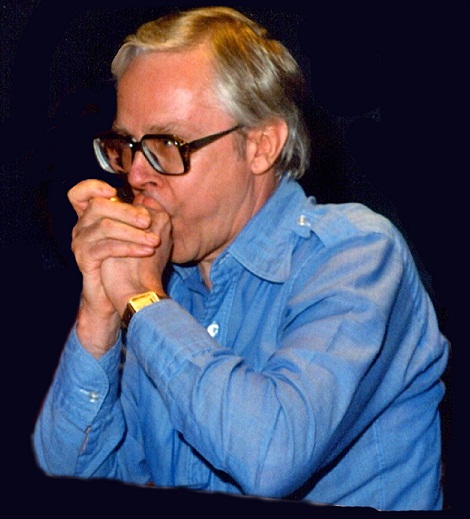
Barry is an outstanding intellectual, influenced by Marshall McLuhan and Northrop Frye. He himself has been a walking, talking encyclopedia, from classical literature to popular culture. Significantly, as well, through life-long excursions into the world of Nature, Barry has connected his mind with his soul. He loves birds, and gifted with a humorous wit, also is renown  for closing keynote addresses (see photo) at conferences with a medley of loon calls.

I participated in several of those conferences with Barry and fellow members of the Association for Media Literacy (AML), who currently have stepped forward to help out in Barry’s final days, as have several of the (now retired) core teachers at SEE.

My own part-time teaching at SEE, a course in Native Studies for eight years, was a most memorable, and creatively stimulating, work experience during many years of cross-cultural activities. Barry always has supported my unique transformative learning approach to media literacy that continues to evolve.

SEE attracted many highly intelligent young adults who were utterly frustrated and bored with the mediocrity fed to them in conventional schools, where being mentally reduced to conform to the status quo seemed to be the predominant agenda of schooling, instead of the development of questioning minds.

In the spirit of what alternative schools do best, the curricula content with the experiential processes of teaching at SEE provoked learners to dig deeper into themselves to discover their respective potentials, and also demand more of them. Thereby, these young people grew more closely into who they could be, by tapping into, and believing in, their own inner and outer capabilities. These offerings awakened possibilities within students that affected the rest of their lives. Stories about these outcomes now are coming full circle in tributes to Barry.

The above glimpse into the life of a great teacher and a dedicated media educator who taught, and practiced, the highest standard of critical pedagogy, yet who also has been a person connected with the Earth and its Life Force, is why I call Barry Duncan “the `green man’ of media literacy.”

First of all, allow me to cite Henry David Thoreau, in a passage from Walden, that eloquently sums up how Barry Duncan lived on this physical plane we call Earth:

“We must learn to reawaken and keep ourselves awake, not by mechanical aids, but by an infinite expectation of the dawn, which does not forsake us in our soundest sleep. I know of no more encouraging fact than the unquestionable ability of man to elevate his life by a conscious endeavor. It is something to be able to paint a particular picture, or to carve a statue, and so to make a few objects beautiful; but it is far more glorious to carve and paint the very atmosphere and medium through which we look, which morally we can do. To affect the quality of the day, that is the highest of the arts. Every man is tasked to make his life, even in its details, worthy of the contemplation of his most elevated and critical hour.”

Well, I’m here to tell you that, as a witness to Barry’s life, up to recent days, making meaning of each day is how he has addressed being alive. Living a life with purpose also is what he strove to impart to his students, and many of them apparently “got it.”

The focus of Barry’s concern to elevate other human beings closer to their potential is the second reason why I refer to Barry as a `green man.’ Symbolically, the `green man’ accompanies the `goddess’ as a perennial figure in many cultures that has lasted from ancient times through the centuries. Visible on churches across Europe, for example, William Anderson, author on spirituality and architecture, writes: “one reason for the enthusiasm of the medieval sculptors for the Green Man may be that he was the source of every inspiration.”

Three weeks ago, I visited Barry in a seniors’ residence, where he has resided in recent months, given the advanced stages of Parkinson’s. The guy amazed me. There he sat, only able to walk with assistance and speaking in a whisper. He spontaneously recited poetry. Barry next persisted in outlining a project that he was trying to convince the residence to organize, as an activity more stimulating than the usual well-intentioned word games, etc. He also was quick to respond to my quirky humour, with which I always can elicit a smile from him, by telling me (not for the first time) I am “a real character.”

During that visit, I had wanted to describe to Barry the theme of my latest blogs, and how I was introducing the notion of interrelating, more consciously, ecological literacy with media literacy through the symbolic image of a `Venus figurine’ shown on my media literacy page, and to whom I refer as `saucy lady’ in blog post “Unearthing the Feminine.”

But, it soon became evident, I simply was called to give loving presence to Barry, who by then only weighed a hundred pounds and astutely aware of his predicament. His desire to discuss a project to benefit others, regardless, epitomizes the essence of Barry.

I departed, promising to bring a surprise the following week. I did so, not to the residence this time, but instead to the hospital – two CDs of music composed by Dan Gibson, one with loon calls and the other, songbirds. Barry’s face lit up when he saw them.

Synchronistically, thank God someone was there, and it happened to be me, when the doctor showed up to give Barry news that devastated him. His deteriorating physical condition was no longer reversible. I heard that part of the news before leaving the room, to give privacy.

Some minutes later, I returned, and Barry was truly shaken up, hope for extending his life shattered. “Sandy, I’m dying, help me.” I centred myself into Zen mode, to calm down Barry (and myself), and methodically address his requests: pen and paper, phone his wife Lynn to come, phone his friend Don to come and help with necessary plans, massage his feet, and give emotional support as he mentally tried to adjust to this new information.

I reassured Barry that I would not abandon him, and I would stay with him throughout the night. He replied, “You have courage.” And so I stayed, through 30 hours until others could take over, a critical period for Barry, feeding him his last spoonfuls of food prior to the next morning, when he no longer was able to digest food at all.

Henceforth, the ground swell of support has been awesome. The tenderness juxtaposed to coordinating pragmatic details, exhibited by Barry’s closest male comrades, is profound. The loving vigilance of longstanding female colleagues, equally so. Visitors/caregivers also include the younger generations of media lit colleagues and former students. Last but not least to witness is the obvious devotion between Barry and his wife Lynn. She is a loving yet fragile soul now heart broken, to whom the rest of us also give support.

So, here’s the thing. If I want to be true to aligning the feminine and the masculine principles for a more holistic vision of media literacy, maybe my saucy lady needs a companion. I need to find and add a green man image. Methinks Barry would like that.

Postscript: William Barry Duncan (1936-2012) passed away peacefully on the morning of June 6 at St. Joseph’s Hospital, and a church service held on June 11 at St. Philip’s Anglican Church, in Toronto, filled with colleagues, former students and family.

Posted in Uncategorized | 6 Comments