
Fighting Causes of Cancer – Living Downstream’s Story

We are together on grandma’s sofa, me as a four-year-old, entrusted with holding in my arms cousin Kathy, a newborn whom I look upon with tenderness and awe. In a card to Kathy earlier this year, I recall that special moment and write that, in my heart, I still am holding her in my arms with prayers for recovery. This blog post is dedicated to the memory of my late cousin Kathy, her life cut short this summer by a rare type of cancer, the causes still a mystery.

How many thousands of individuals continue to have their lives cut short by cancers, the causes unknown? And who are the scientists doing the research to find the answers and, more importantly, pursuing this work in the public, not corporate, interest?

According to American biologist Sandra Steingraber, in North America each year the statistics of cancer deaths now total more than 600,000. That number is each year, a number that she compares with the total losses of U.S. soldiers estimated at 400,000 in WWII, commemorated by a Washington monument, a wall embedded with stars.

Steingraber, in the award-winning film Living Downstream, stands in front of this wall, pointing out how a larger wall would need to be created – every year – if the deaths of cancer victims similarly were acknowledged. For, all of our lives are implicitly engaged in the war against cancer – whether we see ourselves as passive bystanders or pro-active community members who challenge this reality – simply by being alive on this earth today.

This film – based on Steingraber’s book Living Downstream – raises further questions: Why isn’t more effort being invested into full disclosures about the synthetic chemical contaminants ubiquitous in our daily lives, in the air, the water, soil and food supply – and inevitably in our bodies – and where is the political will to ban production of such poisons?
These are just two among the awkward questions to which Sandra Steingraber has dedicated her life’s work, as a biologist, ecologist, cancer survivor, author and as an internationally recognized expert on environmental links to cancer and reproductive health. She wears the mantle, bequeathed by others, as this generation’s Rachel Carson.

What is so impressive about Steingraber, and renders this film so compelling to watch, however, is not just her grace and modesty, yet also a no nonsense clarity of mind and composure in declaring her personal truth and her quest. It is a truth irretrievably woven into the fabric of her quest, to fight against the production and uses of chemicals that are killing us, as well as poisoning the life support system of this planet.

The film Living Downstream illuminates the yin-yang of Steingraber’s personal and professional life, here showing scenes with her family and a cytology check up by her urologist, and there highlighting excerpts from various keynote addresses. In on-camera interviews through which Canadian director/producer Chanda Chevannes follows Steingraber’s peripatetic travels to other places, we follow the life of a woman not only physically on the move yet, moreover, whose scientific mind continues to seek answers. Like Rachel Carson, whom I profiled in the previous post, Steingraber does not suffer fools gladly – ever.

Steingraber has the deepest respect for Carson’s advocacy in an era when the notion was forbidden, in regard to any scientist, male or female, speaking publicly about personal issues. Poignant is the wrenching reality of Carson’s final stages of terminal cancer while at the same time being invited to speak at the U.S. Congress about the findings in her controversial book Silent Spring, mere months before her death. The “C” word was anathema even to Carson’s doctors in identifying her dilemma.

Regardless, in a few scenes intermittently inserted in Living Downstream, we witness Carson’s poise and scientific professionalism. We see her matter-of-factly telling the U.S. Congress: “First, I hope this committee will give serious consideration to a much neglected problem, that of the right of the citizen to be secure in his own home against the intrusion of poisons applied by other persons…I strongly feel that this is, or should be, one of the basic human rights.”

Indeed, Steingraber sees her own life’s work as nothing less than supporting an environmental human rights movement, for which the seeds already have been sown. She advocates that folks everywhere become environmental detectives in their own communities, and demand that the well-being of our children’s lives no longer be compromised by the continuing use of synthetic chemical contaminants around us. She declares:

If we cannot talk about these things, how can we begin to take action…It’s time to break the silence about what’s going on. We need a conversation, and an honest one, about what is happening. That’s finding ways to prevent cancer, not just racing for its cure, as an imperative need.

The reason is, in doing a bit of detective work you might find yourselves as shocked as I am, simply in googling the current status of the chemical “atrazine.” Before I tell you my findings, my choice of looking up atrazine, a weed killer – used extensively in agriculture (and on some tree farms, golf courses and in industry) – is the primary contaminant highlighted in the film. Other poisons are mentioned too, most specifically PCBs, in pointing out how many of them originate from petroleum and coal industries.

In Living Downstream, an excellent, multi-layered film, filmmaker Chanda Chevannes’ investigation also includes the research of several other scientists who, like Steingraber, explain very clearly the step-by-step biological processes how these contaminants accumulate through the food chain of the natural environment. They provide plainly intelligent reasons why atrazine ought to be banned. The European Union did ban it some years ago; but, apparently, not yet in the USA or Canada, according to my brief detective work at this time.

When I googled “atrazine,” the federal government page that comes up for Health Canada is dated 1993 – giving data from close to twenty years ago! But even then, atrazine “was therefore considered to be a Priority A chemical for potential groundwater contamination by the U.S. Environmental Protection Agency (EPA) and ranked highest [my italics] of 83 pesticides in the Agriculture Canada priority scheme for potential groundwater contaminants.”

The conclusions would be comical if they were not so shocking. The suggestion on this page is that municipal, and individual home, water treatment systems can reduce atrazine significantly, and “a full re-evaluation of this compound currently in progress within the Health Protection Branch of Health Canada.” But, where is it?

Environment Canada was no more reassuring. Under the Canadian Environmental Protection Act, 1999, according to its section “Persistence and Bioaccumulation Regulations,” atrazine “was determined to be inherently toxic to humans based on a classification of `Group III: Possibly carcinogenic to humans’ according to Health Canada’s Guidelines for Drinking Water Quality (Health Canada, 2005b).

A citizen could be forgiven for not having much faith that government departments are providing appropriate vigilance to study toxins dangerous to environmental and human health, given the above scenario that I cite here to illustrate a serious problem. In fact, Steingraber in Living Downstream, raises the question about how much evidence does it take before appropriate actions happen, such as banning poisons.

Reporter Tom Philpott’s article, dated April/May 2012, titled “Ban Atrazine NOW!” tells us that the (American) Environmental Protection Agency (EPA) is not beginning to re-evaluate atrazine’s regulatory status until 2013, and no timeline on how long the process would take. Philpott concludes: ” In the meantime, farmers will continue dumping 76 million pounds of it onto farmland annually, to the delight of Syngenta shareholders.”

But, it gets worse. In an article dated February 21, 2012, the title reads “Syngenta Spends Million to Deflect Evidence Against Atrazine Herbicide.” Syngenta is the primary manufacturer of atrazine. The Center for Media and Democracy has gathered more than 200 court documents in a major lawsuit against Syngenta Crop Protection, Inc. This collected evidence proves Syngenta has spent millions of dollars to pay scientists an journalists to deny and deflect the growing documentation of the human health dangers of atrazine.

Why the film Living Downstream is so important is the call by Sandra Steingraber for all of us, as planetary citizens, to inform ourselves about the truth in order to choose specific actions to challenge the intransigence of power holders in government and commerce whose interests disregard the larger good.

In the film we see her elegantly dressed to present a keynote address at the Abraham Lincoln Presidential Museum, in Illinois, to one of her more challenging audiences. Steingraber is no fool. She clearly observes and feels, viscerally, the disinterest by many people there, who include politicians, legislators, CEOs, heads of boards, the types of folks who have the financial and political clout to make life-saving changes.

The contrast is poignant when we also see her visiting her home state of Illinois again, speaking this time in a small, intimate space with local farming families. Among them, she explains clearly the toxic, cancer-causing threats to what ought to be the healthiest baby food, mother’s milk. She cares deeply for these people, and wishes a different future for them.

Steingraber’s compassionate and astute intelligence is the force that drives Living Downstream, interwoven with her unflinching honesty in having no choice but to live through the rest of her life with uncertainty. One touching scene – to which any person diagnosed with cancer can relate – delicately reveals her vulnerability and the need to be strong, when a urology test detects a problem cluster of cells.
At age 20 she had been diagnosed with bladder cancer, and has no doubt that its origins were in the industrial environmental of her home town, Pekin, Illinois. Ten years into her profession as a biologist, she learned about “a vast accumulation of knowledge” connecting certain textile dyes with bladder cancer yet “little done to phase these chemicals out of commerce.” At that awakening in 1993, she left her tenure track job as a biologist, in order to research and produce scientific evidence for the public.

In several of my blog posts, I identify “a split in consciousness” in Western culture as being at the root of so many of our societal and environmental problems, a fact that once again plays out here. The imperative of our time is to mend our disconnected patterns of thinking, which starts with reconnecting the dots in our understanding about the web of life.

For example, each contaminant examined by health and environmental government departments appear to be examined singly, instead of what ought to be obvious, applying a recognition of the web of interrelationships between so many contaminants in our daily lives, hence the multiplied probabilities for cancers. As Steingraber says in the film:

Each study is like a jigsaw puzzle piece, even though all by themselves you usually do not have absolute proof in the case of any one study. But, when you begin to assemble the pieces, all the arrows point in the same direction.

Backstage at a Bioneers conference, she expresses delight in being approached by a woman from her home town. Steingraber, in response to the woman’s question about what to do, says that she never tells people what to do. Instead, she believes: “You have to bring your own passions and interests, and marry you environmental health concern with whatever it is you want to do.”

Two outstanding guides that accompany the DVD package for Living Downstream have been created, respectively, for community groups and school curricula. They embrace a range of thematic approaches for screenings and follow up discussions, written in the spirit of Steingraber’s belief that people can be motivated to choose actions from the starting point of their particular realities, whether rural or urban.

These guides offer step-by-step information from how to hold a screening, conduct a follow up discussion, facilitate workshops, and/or organize a campaign, based on various themes. Included as well are: a glossary of terms, handouts of clearly written background materials, and further recommended resources for citizens and students. Go to Living Downstream‘s website to learn more, and to order the DVD.

Sandra Steingraber’s quest, to fight the environmental causes of cancer, continues. Go to Steingraber’s website to find information about her books and related activities.

May we continue to be blessed with her gracious and intelligent presence in this world for many years to come.
Posted in Uncategorized | Leave a comment

Rachel Carson’s Soulful Call for Environmentalism

The elm tree has a stalwart elegance, even in its leafless state, and tilting from the visible force of the wind. Behind and above the tree we can see the slate blue grey of the stormy sky. The tree is distinctive, standing tall in an open field that gloriously displays the autumn beauty of golden wheat almost flattened by the gale, the field bounded by the muted greens of roadside grass and red-leafed nannyberry bushes.

The image’s creator intended the painting to be an ode to the threatened elm. For me, however, the image always has symbolized the inner strengths of grace and courage of all living beings who withstand destructive external forces.

In recently reading Silent Spring, in its 50th anniversary of first publication, I am reminded of the extraordinary grace and courage of Rachel Carson (1907-1964), deservedly heralded as kick-starting the post-World War II environmental movement. The reason is, Carson took science out of the control of industrial laboratories and government offices, and made available important knowledge to the larger public for the first time, to awaken us to the fact that environmental and human health are interwoven.

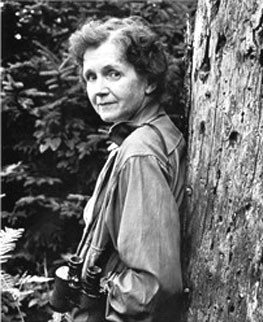
In doing so, she is a heroine in all respects, professionally and personally.Rachel Carson When I now look upon the painted image of the lone elm in the field, vulnerable to the stormy elements, I see Carson’s apparition within the elm tree’s body. Her gaze is directed, clear-eyed, at the viewer, as in this photo of her leaning against a tree trunk, in Nature where she experienced inner peace.

This woman does not suffer fools gladly. The woman we see here has been toughened by both private and professional battles. The cause of the latter was her discovery, then exposure of, the sordid truth behind the life-threatening actions of the chemical industry and, worse, such actions rubber stamped by government. She finds the scientific and medical studies that prove, empirically, why DDT and several other chemicals, are deadly poisons.

Meticulously, for example, in Silent Spring, Carson describes how the DDT spraying to stop the spread of Dutch elm disease, killed not just the predatory bark beetle. But, moreover, the spraying poisoned the trees’ leaves, all insects who ate the leaves, the earthworms who fed on leaf litter, the soil and the robins who fed on the earthworms – in other words, DDT destroyed an entire food chain.

Similarly, Carson described how several other chemicals were just as lethal to all forms of life, from all species in Nature as well as the soil, water and air, to human life, most especially children. Indeed, children were dying and many people were being afflicted with chronic, if not terminal, illnesses. Silent Spring includes 55 pages listing her principle sources.

Carson’s diligent research to reveal these facts must not be underestimated, for she was a scientist in her own right. How she presents information demonstrates her gift to translate complex knowledge into layman’s language, in order to be accessible to the larger public.

Furthermore, the depth and breadth of Silent Spring indicates a special capability to interweave multidisciplinary investigations as well as an implicit understanding of the principles of systems thinking. Carson understood – both experientially from her own inquisitive explorations in the world of Nature since early childhood, and also empirically from her post-secondary studies in aquatic biology and zoology – that all life is interconnected.

Her understanding, however, was exceptional in Western culture, then and now – a culture that systemically is slow to shift its collective consciousness to holistic insight.

Carson had to terminate doctoral studies for two reasons, The Great Depression and her father’s death from a heart attack in 1935, to support several family members. Few jobs in science available to women, she found a job writing radio scripts about the ocean for an agency that later became the United States Fish and Wildlife Service.

At this point in her story, one wonders whether destiny was at play in the direction Carson’s life took – the path of the writer and storyteller rather than a full-time job as a scientist, where her days thereafter could have been imprisoned within laboratory walls.

That first job gave Carson access to primary science sources while, importantly, developing her gift of writing. On top of a full-time job, she also produced freelance articles for magazines up to, and following, the publication of her first book Under the Sea Wind (1941). The next book was The Sea Around Us (1951), completed a year after her first breast tumour was removed.

Her first book received several awards, and persuaded her to leave government service, regardless of being given several promotions, so that she could write full-time. The Edge of the Sea (1955) became her third book – again, each book published to acclaim.

But, life was getting more complicated. Upon her sister’s death, Carson adopted nephew Roger, while also increasingly assaulted by her very private battle against terminal cancer that cut her life short in 1964. In 1960, she had a radical mastectomy. The entire Silent Spring (1962) book project, and beyond, was beset by a number of physical setbacks.

Her heroism, therefore, is two-fold. For in pursuing her research on Silent Spring, the societal battlefield ahead became increasingly clear, although not the extent of the future guns directed to the attempted destruction of her professional integrity and personal dignity.

The guns included: shameful sexism, slandering and soulless arrogance; denial of factual scientific truth; and, of course, the ubiquitous reality of the economic power and pressure of the chemical industries. The ugly wrath that would pour down upon her after the book’s publication came from individuals in the scientific establishment hired by the chemical industry, and also economically compromised politicians.

Former Audubon biologist Roland Clement, in a 2012 interview, told journalist Eliza Griswold: “the chemical companies were willing to stop domestic use of DDT,” but only if they could strike a bargain with politicians to continue export of it to foreign countries. As for the National Audubon Society, it would not even endorse Carson’s book.

Thank goodness there always have existed more intelligent souls through history, who usually tend to be those in dissent of the status quo. They do not submit to threats from the power holders. The dissenters this time included certain esteemed scientists, such as E.O.Wilson, The New Yorker magazine which serialized Carson’s manuscript, and her book publisher Houghton Mifflin.

Furthermore, President John F. Kennedy himself, after reading Silent Spring, called for the creation of a Science Advisory Committee to do independent research and publish a pesticide report. It confirmed Carson’s findings. Since her death, various pieces of environmental legislation have grown from the inspirational, and life-affirming, soil of that courageous book.

An outstanding online exhibition now exists that maps the trajectory of the book’s influence that continues today, titled “Rachel Carson’s Silent Spring, A Book That Changed the World.” The website’s content spans a timeline from a 1963 CBS Reports television interview in Carson’s home, and the ugly attacks by industrial and agricultural interests, to the ongoing influence in education, popular culture, literature and the arts, and 2007 TV programs revisiting Carson’s legacy, seen on CBS News and Bill Moyers Journal.

The exhibition website author writes: ” Moyers intended his program to counter the libertarian-conservative attack on Carson.” Even five years later, in 2012 – fifty years following Silent Spring‘s publication – the premise of her life’s work still is debated!

The good news is, such debate gives proof that her influence has been powerful indeed. The bad news is, the fact that such a debate continues sadly illustrates that North American society still has a long way to go to appreciate the fundamental message in her writings: Humans are biological beings interconnected with all forms of life on this planet; and what befalls the earth, water, air and all other species also befalls us.

A clue about the root of the problem, as I propose below, resides in the feature article by Eliza Griswold, September 21, 2012 in The New York Times titled “How `Silent Spring’ Ignited the Environmental Movement.” For I totally challenge this statement by Griswold: “But if `Silent Spring’ can be credited with launching a movement, it also sowed the seeds of its own destruction.”

Blaming a book, a person, or a movement, for the growth of political fracturing in the USA and other nation states, and increased partisan reaction to environmentalism, overlooks the root problem that has led to a divisiveness that is not limited to the environmental movement but instead could result in the severing of societal stability.

The root problem, I suggest, is the split in human consciousness through centuries, particularly in the West. This split has led to the consequences of industrial capitalism, globalization and the commodification of life.

A growing number of planetary citizens are saying, enough. We must change how we live on this planet. The divisiveness, therefore, is between people who hold on, and try to perpetuate, an environmentally destructive economic system, and those who want to co-create new ways of interrelating, ecologically and economically, with the planet’s life support system.

Two of my earlier blog posts provide a theory behind this split in consciousness, given by the late Leonard Shlain in his book The Alphabet and the Goddess. Shlain, a heart surgeon who studied the brain, describes the two brain hemispheres, right and left, as representing respectively, the feminine and masculine principles that, together, enable fuller, balanced thinking. He also explains how and why the feminine principle has been diminished in patriarchal cultures, with an emphasis on the West.

Our collective challenge, therefore, as a human family across cultures, is the task to shift our human understanding, step-by-step, to integrate the feminine and the masculine principles and function much more in balance. This is the life journey towards our human potential, to come home to our soul, to awaken those qualities innately within each of us to become whole, and work together to heal ourselves and our imperilled planet. The possibility always is there for us to choose.

In Paul Hawken’s important book Blessed Unrest, my September blog post cites his recognition of Carson’s ground-breaking accomplishment in Silent Spring. Hawken, moreover, speaks to the global grassroots movement happening everywhere, which “sees the feminine as sacred and holy.”

Given the inevitable internal ruptures within an ever-evolving environmental movement, it is refreshing to read Paul Kingsnorth’s August 1, 2012 article in The Guardian, provocatively titled “The new environmentalism: where men must act `as gods’ to save the planet,” which he challenges, astutely. His argument is well worth reading, because it pulls us toward the essence of Carson’s message – for individuals to take responsibility to engage with natural environments as we experience them in lived reality.

Meanwhile, what speaks more about the omission of soul among Carson’s critics than about what they criticize in her is their failure to recognize her inner and outer strengths. Spiritual, emotional and intuitive resources, nurtured by direct experiences in Nature, comprised the feminine principles that carried her through daunting circumstances, including the knowledge of her own imminent death.

Yet, these feminine principles are what her critics labelled as weaknesses, while they were further ignorant of the fact that she aligned the best of the feminine with the best of the masculine, in expressing the latter through intellectual, analytical, pragmatic productivity.

Carson’s spiritual fortitude is brilliantly conveyed by screenwriter/actress Kaiulani Lee in her one-woman stage play A Sense of Wonder, performed around the United States and filmed for PBS-TV. I strongly urge you to watch Bill Moyers’ interview with Lee, and see a few excerpts from the play, on the September 21, 2007 Bill Moyers Journal episode. Carson’s soulful call for environmentalism is powerfully communicated in this play.

One poignant moment shows Lee, as Carson, reflecting on the invitation by the editor of The New Yorker to serialize Silent Spring. She recalls in a softly spoken voice how, upon hearing that news, she had put on a recording of Beethoven’s Violin Concert, and let the tears come. Her work would reach the wider public after all.

Last but not least, another website presentation of Rachel Carson’s life, generously shown by her biographer Linda Lear, at The Life and Legacy of Rachel Carson, can take you to several insightful sections. Clicking here, however, directs you first to a photographic series that begins with my favourite portrait of Rachel Carson, that exquisitely radiates the visage of her gentle soul.

May her heroism and writings continue to teach and inspire.

Posted in Uncategorized | 2 Comments

Interlude – Roughing It at the Farmhouse

The sun was shining, for the first time in many days. Outdoor chores were calling, the necessary late autumn clean up before the first major snow. The overgrown mass of vegetation close to my cellar door especially needs clearing, so that the cords of wood soon to be delivered can be tossed down the steps and stacked inside. I still have wood left from last year because of a mild winter. They say the upcoming winter will be tough.

In a world of uncertainty, weather is the least certain of all, particularly as weather patterns are changing radically because of climate change. The widespread resistance to accepting the latter reality has dumbfounded me through many years, since the initial signs and warnings first were made known, yet mostly denied and ignored.

Denial and ignorance no longer are options, given the latest `perfect storm,’ “perfect” in its uncontrollable wrath and infliction on the most stubborn and willful species on the planet – humans. More storms similar to Hurricane Sandy will happen, as day follows night. How coastal cities and island nations will cope is an open question.

Among the recent beacons of hope, to address the fact of climate change squarely, was a bluntly titled cover story, November 1st, in Bloomberg Businessweek, “It’s Global Warming, Stupid.” Paul M.Barrett’s feature article represents, by its very publication, a solid awakening in the business community, beyond boardroom debates.

The Businessweek article includes intelligent research that covers various bases that one would think state the obvious. We no longer can blame just corporations or government policies. Barrett cites author/journalist David Owen that “as long as the West places high and unquestioning value on economic growth and consumer gratification – with China and the rest of the developing world right behind – we will continue to burn fossil fuels whose emissions trap heat in the atmosphere.”

Barrett’s article exists, because the most elementary facts seem to continue to get struck out of the playing field of visibility. Continuing the baseball metaphor, we are holding the ball in our mitt, collectively, as individuals alive at a historic moment in which developed countries are consumed by consumerism, while developing countries aspire to that type of future (according to news media owned by multinational corporations which depend on the present economic system).

Among those of us who are in the developed world, we have the ethical responsibility to change our extravagant way of life instead of looking like the type of `promised land’ which the developing world is being misled to follow. Each and every one of us needs to ensure the continuation of freedoms that we take for granted, by acting now less selfishly for the larger good in daily choices about how we interpret `quality of life.’

Otherwise, freedoms such as breathing clean air, free accessibility to uncontaminated water (or any water at all), and sustainable food and shelter will be seriously diminished in the so-called `developed world,’ as they already are elsewhere. Such freedoms do not exist in the `developing world’ for reasons that reside in corporate greed and willful denial of moral responsibility not just by corporations. For all of us are complicit by not examining the global costs of our own comforts and conveniences that we demand.

My goodness, once again, here I am on a podium. I initially intended this blog post to be a lighthearted interlude, taking a break from the serious issues of our time. What I love about blogging, however, is to speak my truth as a person who genuinely cares about humanity and this beautiful planet, upon which I have enjoyed travels to different places in the world.

I take the gift of being alive very seriously, perhaps because I have come too close to losing it more than once. My first blog post, “The Gift of Being Alive,” in fact, focused on the aftermath of what could have been a fatal car accident a few years ago.

Travel can be the best education of all, when the traveller makes the effort to walk among the people who are `native’ to each land. It boggles the mind to know that a certain breed of `tourist’ chooses only those hotels anywhere they travel that offer all the comforts of home, and may not even step outside the hotel property (except from and to the airport) to broaden their mind nor deepen their soul. They experience nothing of the authentic culture, but instead witness merely stereotyped constructions of non-Western cultures, for entertainment.

Aside from my own more adventurous trips abroad, I have been blessed most of all to visit among the `native’ or Aboriginal people of my own land, Canada – First Nations, Metis and Inuit. I have stayed in their homes and communities, being trusted as they shared knowledge from their respective authentic cultures – not as entertainment. Instead, their generosity helped me to learn and respect the depth and breadth of a land-based way of life enriched by experientially lived ecological awareness, an awareness, moreover, honoured in spiritual traditions. Such travels changed my life forever.

Indeed, they were instrumental in reinforcing my childhood dream to live immersed in Nature later in life, and get far away from the city, while still strong enough to chop wood and experience a simple way of life close to the earth, before I die. The joy and inner peace that I have found in countryside living is the most precious gift of all, to me far more valuable than what was, for me, a soulfully impoverished urban lifestyle.

How can I write about reverence for the earth and all species, unless I am `walking the talk’ through lived experience? How can I speak to the need for human beings to seek teachings and practices to bring more balance into their lives, unless I can demonstrate my own efforts? Some people, bless you, can create a soulful balance within the city. My soul journey took me elsewhere.

For anyone who assumes I have run away from a major city to escape the world’s problems, nothing could be further from the reality. Instead, I mustered the courage to run towards a deeper reality, to discover who I can be, and grapple with new and unfamiliar challenges that would sorely test me. They have done so.

Rural living is not easy, and definitely has its own environmental issues to address. Yet living here also has its own rewards through the pursuit to understand what actually makes being alive joyful.

Here I come full circle to the initial theme of this blog post – roughing it at the farmhouse. The paradoxical yin-yang of it is that the rough, pioneer-style labour required to attain (not readily accessible) bodily comforts, such as keeping warm, is precisely where the joy and inner peace awaken, serendipitously.

Sometimes confronted by awesome, if not bizarre, situations, also is where the comedy of life can surface. Comedy transports me to a realm away from the mundane stresses of life such as finding work to pay the bills and other similar realities to negotiate.

The latest comedy of errors yesterday was trying to eliminate the chaotic vegetation close to my cellar steps, totally covering over the flagstones. First, I assembled a new electric trimmer, after trying to interpret the instructions. I next needed to access an outdoor plug. But, before doing so, I had to traverse an incredible tangle of vines that blocked my way up the porch steps to the plug. Hacking away with large clippers, I found myself in stitches, in wonder at the vine’s resilient, and numerous, intertwining offshoots.

The day closed with me still unable to see the flagstones. Alas, today it is raining. In this season, prone to wetness, will I ever clear up the cellar entrance and areas of the porch where various plants have grown through the boards? Truth be told, part of me is tempted to let them be.

This domestic adventure has reminded me about something vitally important to my well-being. In fact, I will be so bold as to suggest that it speaks to what provides well-being and wholeness to human life, and needs to be rediscovered by individuals of any generation allowing themselves to have every waking moment consumed by technological gadgets.

Ever since my childhood days of running freely in woods and wide-open fields – that are my happiest memories – I am reminded that what makes being alive joyful for me is the wildness of Nature. For it speaks to that wild, untamed aspect of the human soul.

The vitality of the soul is the life force that I believe exists within each of us, and essential to carry us across the valleys, forging of rivers, and mountains, that our life journey confronts. I speak here to our inner landscape there to discover and traverse, and not solely the inevitable outer world challenges.

The pursuit of that journey of self-discovery is where we awaken the joy and find the inner peace. Our purpose in being alive is not based superficially on the pursuit of happiness, but instead coming to the recognition, as my late friend Everett Soop once said: “tragedy and comedy actually hold hands,” and developing the grace to accept that reality.

Posted in Uncategorized | Leave a comment

Memories of New York and Prayers After the Storm

My prayers are with those people in New York City and the State of New Jersey, whose lives have been changed forever after Hurricane Sandy. What I pray for is the compassion and generosity of more fortunate people to open not just their wallets, yet also their homes wherever possible at this moment of oncoming winter. May you come together as communities, to help in this overwhelming period of transition for many folks looking at a different, and uncertain, future. For you, do not lose heart.

New York City is one of the world’s great cities, and may it continue to be so. Great cities are based not only on grand monuments, celebrated institutions and other markers of status created with money. More importantly, great cities have people endowed with a largesse of heart, who envision greatness in human possibility, and exercise it through actions that transform and enhance the human family.

What came to mind so powerfully this past week have been reminiscent moments of three visits to New York City, each visit more than a decade apart from the others. Even so, particular moments remain indelibly written on my memory as if they had happened yesterday.

That is the magical power of a great city, and it does not mean that such a city is perfect. In New York City everything is larger than life, such as the extraordinary evidence of achievements through generations, by all social classes. Indeed, truth be told, some accomplishments happen, heroically, despite continuing social and economic inequities.

It was early spring 1970 when my fourth-year class from the Ontario College of Art, in the Department of Drawing and Painting, unpacked our bags at the Times Square Motel. We spent a glorious week stomping around the SoHo art district during the day, and scouting the entertainment district of Times Square and Broadway, evenings – nothing upscale or trendy. In those days, artists and performers could afford modest digs in these districts while honing their diverse talents.

One evening I really had the `mickey taken out’ of me, as an aspiring stage designer and part-time student as well at a Toronto theatre academy. Seeking a book on one of George Bernard Shaw’s plays, I stopped outside one bookstore and decided to enter, looking for Mrs. Warren’s Profession. My assigned theatre student task was to design a set. Chirpy and innocent, I walked into what turned out to be a bookstore for pornography. Minutes later, resurfacing with no book, my classmates almost were rolling on the sidewalk with laughter.

Art Nouveau and Impressionism have remained among my favourite styles of art. On another evening I was dumbstruck, gazing in the doorway of an eatery, to see the vision of a figure that seemed to have stepped out of a Toulouse-Lautrec painting. An African American man was standing in a pose exactly like “Chocolat dansant dans un bar.”

Did you know that the multiple talented Gene Kelly struck the identical pose for a scene in An American in Paris? Director Vincente Minnelli integrated a lot of Impressionistic imagery. The 1951 MGM musical film was inspired by the 1928 orchestral composition by New Yorker George Gershwin, with lyrics by his brother Ira. Both Gershwin brothers, and also Gene Kelly, contributed to a lasting artistic legacy that continues to speak to the human heart.

More seriously, as a Canadian, I recall sitting bug-eyed one lunch hour while a New York police officer pulled off his jacket to expose a pistol for all the world to see. Then, there was the issue of just walking along the streets with my classmate David, who happened to be a Black Canadian. Both of us were given dark looks and subjected to rude and vulgar names. Such was the racism of the time, blatantly overt in the USA. In contrast, back home in Toronto, in our art college identities, we all were stigmatized equally, as `hippies,’ simply in our desire to become professional artists (and, more so, as participants in `sit-ins).’

The final big surprise was taking a short walk with another classmate, a block down the street from the Times Square Motel, to buy some snacks. The shop keeper cautioned that we should not be out that time of night. For heaven’s sake, it was only six o’clock; but he already was closing up. Sure enough, we two girls actually did sense being followed on our return trip, and never walked outside the motel again unless accompanied by our male classmates.

That memory brings me to the year 1987, when I was doing a series of interviews with a Native American photographer, who was a real tough cookie, and had to be. I do not mention her name, to protect her privacy. She lived in a neighbourhood run by the Porto Rican mafia, who did not mess with her as long as she kept quiet about any suspicious-looking activities on the street. In other areas of the city she had been mugged, twice, and repeatedly instructed me not to look like a tourist.

Doing so was not a stretch since I was living on a subsistence income as a writer. I walked miles just to save bus fare, to and fro from where I stayed with one of her friends, sleeping on a sofa. The reason was, her own flat looked more like a large closet than a small apartment. She reassured me that the mafia would not lay a hand on me where she lived, because I knew her.

Her words provided minimal comfort, given the several other neighbourhoods to walk through on my daily trips. En route, what broke my heart were the blankets laid along the sidewalks each night, on which were placed various items for sale, so that the owners could get enough bits of money to survive another day.

What truly humbled me, however, were the `pocket gardens’ distributed through these poor neighbourhoods. I refer to small, boarded, 4×8 foot plots of earth, each cared for by one or more individuals. They planted flowers and, sometimes, vegetables, all lovingly tended. My Native American friend tended several plots, and these usually were the places where we would sit for our conversations. She told me that no one ever vandalized them.

The local folks, many homeless, all took great pride in protecting these pocket gardens. For they embodied the beauty, and life force, of Nature – life as it ought to be for all living beings, when respected and nurtured.

Some of the homeless, in fact, slept in vacant buildings considered hazardous, and their repair neglected by the city. As for the many people who slept on the streets, even in areas in Manhattan, I never believed that that reality could happen in Toronto. Well, I was wrong. Shamefully obvious is the fact, as a city grows, with the veneer of greater economic wealth, the divide between the rich and the poor becomes greater as well.

In the year 2000, the Native American Film and Video Festival, organized by the Smithsonian’s National Museum of the American Indian, invited my documentary film Soop on Wheels. I instinctively felt safe travelling through Manhattan alone, in daily trips to and from the museum and my hotel room, even late at night. Golly, I thought, New York City sure has changed. Or did it only look that way to a short-term visitor? One question has continued to haunt me: Where do the poor now live???

But, residential accommodation size had not changed. My very modestly-priced hotel room was barely big enough to swing a cat. I had to climb over the bed instead of walk around it, in order to get inside the bathroom once the bathroom door was opened, hitting the bed. In those years, I was no longer living on a subsistence income as a writer, but instead as a documentary filmmaker. Regardless, I loved my life and my storytelling work.

Not much else to relate here about adventures in 2000. Most waking hours at a film festival are dedicated to trying to see as many films as possible until you are pie-eyed, chatting with other filmmakers, schmoozing and promoting your own film, and surviving mostly on popcorn, muffins, free munchies and drinks for filmmakers, and coffee, through several days.

I will spare you the saga of trying to open my locked suitcase after I lost the only key, a tale which could resemble a slapstick short film starring a female Charlie Chaplin in regard to how the frigging thing finally got unlocked.

May the above tales bring a smile to the faces of whoever reads this blog post, as is their intention, especially to bolster the spirits of any folks in NYC, and also New Jersey, who might discover my blog.

Consider how storytelling can be a positive and strengthening activity, whether oral in the moment or following an event, as well as written or video-recorded. Our stories help us make meaning of life’s events, regardless how traumatic.

Gather groups of folks for talking circles, in which everyone receives an opportunity to share a story. Such circles can be very healing, when folks feel that their voices are being heard by others who care.

Posted in Uncategorized | Leave a comment

Alphabet Versus Goddess – How Stories Shape Us

Never underestimate the power of written words. Certain words on certain documents changed and influenced human perceptions of the world, and beyond, for thousands of years. What also is noteworthy is how the awakening of our own power to read between the lines can be instrumental in understanding documented stories more deeply.

Before I even knew about media literacy, I had a consciousness-shifting experience one evening at a presentation by a maverick archeologist. He identified what was omitted, and what was misrepresented, in The Jesuit Relations. These 73 volumes, documenting the anecdotal life of Jesuit missionaries from Canada’s eastern coastal provinces to central Canada from 1610 to 1791, have been used as resources by historians and fictional writers for five centuries up to, and including, pop culture today.

But, to this day, regrettably, few people are aware what has been misrepresented. In an academic paper, as well as later journalism articles, I wrote at length about what I will identify, briefly, here. The Jesuits, similar to other Christian missionaries, had no concept of the the already-existing spiritual life and practices of Indigenous peoples. Therefore, particular descriptions of, for example, spiritual ceremonies and daily morning prayers of gratitude to Creator, sadly, were ridiculed and distorted. Instead, specific rituals were characterized by various Jesuits as anything from meaningless loud shouting to devil worship, instead of, correctly, as sacred activities.

These Jesuit writings demonstrate the destructive lack of awareness of missionaries so powerfully instrumental in diminishing and demonizing ways of worship other than Christianity. Indigenous spiritual practices, in truth, showed gratitude and respect for Creation that was experientially lived. Meanwhile, the missionary perspective continues as a form of unnamed cultural racism predominant in our systemic Western consciousness. Transforming such misguided consciousness is an ongoing project for cross-cultural and planetary healing.

The essential need of our time for the evolution of consciousness also is why I consider Leonard Shlain’s book THE ALPHABET VERSUS THE GODDESS, The Conflict Between Word and Image, as so important. In my previous blog post, I outlined Shlain’s physiological description of the lateralization of the human brain. I also cited how Shlain clearly identified the functions of the right and left brain hemispheres, respectively, in relation to images and written text.

In this blog post, I want to offer a few sociological insights, citing examples from Shlain’s book, why cultural upheavals happened when human societies marginalized spiritually-symbolic images and replaced them by “The Word,” in Judaism, Christianity and Islam. Indeed, Shlain writes, regarding these three religions: “Each is an exemplar of patriarchy. Each monotheistic religion features an imageless Father deity whose authority shines through his revealed Word, sanctified in its written form” [Shlain, 1999, p. 7]. He elaborates:

“Around 1500 B.C., there were hundreds of goddess-based sects enveloping the Mediterranean basin. By the fifth century A.D., they had been almost completely eradicated, by which time women were also prohibited from conducting a single major Western sacrament” [p. 6].

The initial shift from image to writing, therefore, predated the biblical Old Testament. “Sumerians took the first step in a process that would reconfigure all human relations,” writes Shlain. “In their oldest stratum, the Sumerians venerated a supreme female deity.” But, beginning in 3100 B.C., Sumerian pictographic cuneiform ideograms progressively evolved from visual signs to stylized symbols to represent “an idea, concept, object, or action” [p. 46-7]. Regardless, their creation still integrated the right and left brain hemispheres.

When the Akkadians conquered Sumer, however, “they adapted cuneiform by inventing phonograms, symbols that stand for syllables of speech,” eventually evolving into “phonetic writing” for which they replaced previous patterns into linear arrangement. This transformation, moreover, replaced the status of the Sumerian goddess, Nisaba, perceived as the giver of cuneiform characters, with the Akkadian god of writing, Nabu.

What followed illustrates how the former reverence of the feminine principle by the Sumerians was superseded by a radically different creation myth “recited every spring in Babylon for the next thousand years,” writes Shlain. Indeed, in The Seven Tablets of Creation, the Great Goddess Tiamat is dismembered by the god Marduk. Shlain exclaims, “in the field of comparative religion, there does not exist a more misogynist and macabre story” [p. 50].

In looking up this myth, also known as Enuma Elish, I found a website showing the 1902 translation by L.W. King, where the introduction points out: “The Enuma Elish has long been considered by scholars to be the primary source material for the book of Genesis. It has also been hypothesized that this is a legend about the overthrow of the matriarchy or records of some cosmic catastrophe.”

Shlain points out another event contemporaneous with the mythic dismemberment of the Great Goddess Tiamat – the creation of the first written legal code of law by Babylonian chieftain Hammurabi. In fact, Hammurabi believed that the god Marduk had chosen him to rule over Babylon, and initiated the man-made doctrine of the `divine rule of kings’ in Hammurabi’s Code.

Various scholars have praised the merits of this first extensive written code of law. But, Shlain is not alone in identifying its shadow side. In looking up Hammurabi’s Code, I discovered another source (also used by Shlain), Gerda Lerner’s The Creation of Patriarchy. Lerner apparently used Hammurabi’s Code as supporting evidence for the eventual codification of patriarchal values in extensive, bureaucratic civilizations.

So, folks, think about it. Patriarchy goes back a long, long way, deeply entrenched in institutionalized religion as well as legal codes of law. Herein, as well, are the seeds of bureaucracy that plague us to this day – and questionable, given the emphasis on left brain thinking rather than the fuller, holistic capabilities of the mind. As Shlain points out: “laws press down upon the people and can be initiated and manipulated by a privileged literate elite” [p. 51].

Shlain emphasizes, however, the cognitive outcomes of shifting from image to text could not have been known in those early centuries of developing alphabetic script:

“For sophisticated neurolinguistic reasons the early practitioners could not have known, alphabets reinforced only half of the dual strategy that humans had evolved to survive. As we have seen, this strategy had three components: left brain/right brain, cone/rod, and right hand/left hand. Each tripartite half of this duality perceived and reacted to the world in a different way; a unified response emerged only when both complementary halves were used” [p. 66].

Indeed, how many people even today are aware of this fact, a fact that plays a major role in why stories are so potent in shaping what we think we know about the world?

Chronologically through the centuries, Shlain gives evidence how the treatment of women improved or deteriorated in conjunction with periods of transition that shifted a culture focused on oration and images to the dissemination of literacy throughout the population, most particularly in religious texts. Go to the website for The Alphabet Versus the Goddess to scroll the timeline generously provided.

Another sociological insight, aside from how the manipulation of written words fostered the origins of patriarchy, is the split that resulted between the spiritual and the religious. This split happened when `spiritual’ beliefs and practices became encoded in written dogmas and doctrines. Something significant was lost – namely, the integrity of the original teachings by Jesus, Mohammed, and also Buddha.

In The Alphabet and the Goddess, Shlain illuminates at length how and why the original oral teachings, not written down by the actual spiritual founders of the subsequent religious movements, were either unconsciously misinterpreted or very intentionally reinterpreted, in accordance with the self-serving agendas of power holders at different historic periods.

Shlain explains how the tragic ruptures of entire societies were based not simply on religious wars. But, moreover, he outlines how religious wars repeatedly involved the smashing of images and stripping away of women’s rights once again, while imposing yet another religious document on how to conduct religious worship of God. Forget religious freedom, or any comprehension abut what is authentically spiritual. Therein resides the core of the split in human consciousness.

Some of you may know the story how Siddhartha Gautama became a Buddha, an `Awakened One.’ He founded a religion in which there was no deity to revere. Shlain writes that, like Socrates, the Buddha was contemptuous of the written word, and discouraged his disciples from transcribing his words. Further to Buddha’s views:

“He taught that rituals, priests, prayers, demons, angels, devotions, sacrifices, supplications, and incantations were all worthless. He claimed that religious hierarchies were designed to benefit only priests. He resisted the temptation to promulgate a code of law, believing that all laws imposed by an authority eventually degenerate into tyranny” [p. 172].

Well, history tells us that Buddha sure got that human probability right. So what happened to Buddhism and why, through later centuries? For the original teachings were grounded in `wisdom’ and `compassion,’ “two concepts traditionally associated with the feminine principle” [p. 174], and many other feminine motifs, such as: nonviolence, equality for all, universal love, and the horizontal layering of society.

Shlain concludes that we never can know for certain how accurate are the later stories about Buddha in a doctrine “based on feminine principles but contains an abhorrence of sexuality, a suspicion of women, and a negative attitude toward birth” [p. 178]. Shlain, compassionately, points out one consistent fact in various sources: the real life Siddhartha Gautama’s mother died giving birth to him, a profoundly traumatizing event for any child.

My three closing comments are the following. First of all, I invite you to read one of my earlier blog posts, partly relating the bravery of Quan Am Thi Kinh, a historic Vietnamese woman who made possible the building of the first temple in Vietnam for women to be ordained and to practice as Buddhist nuns. My source for that little known story is The Novice, a novel written by Thich Nhat Hanh, Vietnamese Buddhist Zen Master, and author, who himself has faced persecution in today’s world. Thich Nhat Hanh, regardless, devotes his life to supporting actions for world peace.

Secondly, I highly recommend reading The Alphabet Versus the Goddess, about which two blog posts cannot do justice to the diligent research gathered by Shlain, and his pioneering theory. His book addresses the human family from our hominid beginnings through history to today, mapping how the shift from images to written words impacted upon every major religion and culture. Yet, ultimately, his message is one of hope for the human family.

Third, and finally, I too am hopeful. Oppression has existed throughout human history. Yet, always, sufficient numbers of human beings have risen up to transform it. Despite the biases embedded in institutionalized religion, always, certain individuals even within these institutions retain their spiritual integrity to speak out against unequal treatment caused by doctrines that benefit the privileged few at the expense of well-being for all.

The possibility to co-create a better world, always, resides within the heart and soul of each of us.

Posted in Uncategorized | 4 Comments