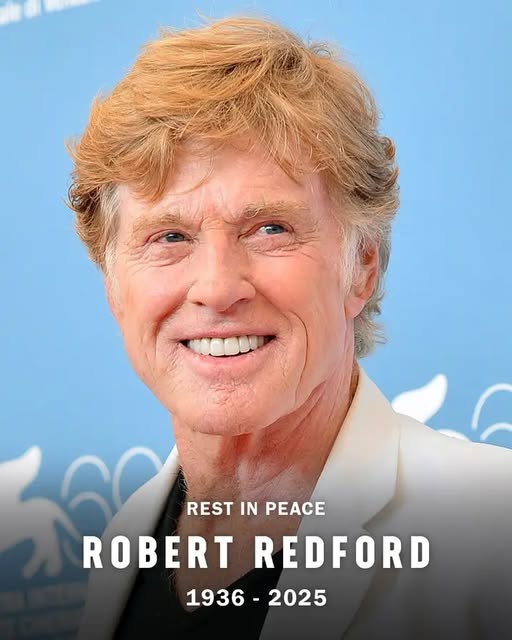
My Encounters with Robert Redford – His Legacy Can Teach and Inspire Us All

Remembering Robert Redford (1936-2025), for me, is not limited to an exercise in looking back in time to the three occasions where we exchanged words but, moreover, compels me to reflect on how those encounters have continued to motivate me as a storyteller.

Across the internet are many accolades about Redford’s contributions. Nevertheless, one continuing thread in his lifelong activities has been side-lined, namely, his support for Indigenous peoples, both in challenging various forms of injustice and also in showcasing Indigenous-produced films at Sundance Film Festival, the latter ahead of its time in supporting independent films, and documentary storytelling specifically.

Among the qualities which I most admire about Redford is, to achieve all of the above, he took risks, huge risks. He did so, not to gain fame but instead to address the larger good and challenge the human condition. Doing so was not easy then, nor is it easy today. Anyone dedicated to truth telling will confront never-ending obstacles based on behaviours of greed, racism, willful ignorance, and simply cold indifference.

The first time that I directly spoke to Redford was at a press conference at a film festival in Toronto, Canada, promoting A River Runs Through It (1992). Redford was the director and also did the voice-over narration for the older brother (in real life, Norman Maclean, who was depicted in the film by Craig Sheffer). Previously, I had read the semi-biographical novella by Norman Maclean (1902-1990) based on his family between the two world wars. I stood up to comment that Maclean’s original story was racist and ugly in how a native American female character was depicted – although authentic to the blatant racism of that era. She was a love interest of the younger Maclean brother, a rebellious news reporter (portrayed in the film by Brad Pitt). I vocally observed, in contrast, how the film depiction was much more nuanced, while not shying away from the reality of cultural discrimination.

The point here is that that film demonstrated, in all of the characters depicted, a grace and sensitivity by Redford in his discernment that extended beyond individuals to address the bigger interwoven layers of messy social and cross-cultural dynamics as well as the unseen depths of human woundedness (the latter not for the first time, of course, – recall Ordinary People). Also notable was how the natural environment and the elemental joy of fishing offered a counterpoint to outer and inner human turmoil.

My second encounter with Redford happened in 1994, when I attended the Sundance Film Festival as a freelance journalist, the year a “Native sidebar” of films was introduced. Upon the close of the press conference, as the room emptied, I boldly walked up to Redford, and inquired whether he had received a package containing several of my articles on Indigenous people (which I had mailed a few weeks earlier). His face lit up as he enthusiastically said, yes, and added how much he enjoyed and appreciated them. We continued to talk while walking together outside to a flurry of folks wanting his attention. His modesty and graciousness to everyone made a lasting impression on me.

I probably levitated afterwards through the entire film festival, while doing interviews with Indigenous actors, from which articles subsequently were published in a couple of Native American magazines whom I wrote for regularly. Sadly, by 1992, almost all Indigenous newspapers and magazines across Canada – for which I had contributed many times – had lost federal funding and, consequently, disappeared. I hope their respective editions are archived somewhere, because all of these Native publications contain valuable insights to Canada’s cultural history through moments in time, from grassroots Indigenous perspectives.

The third, and final, time that Redford and I spoke face to face happened in 2000, when that year I attended Sundance Film Festival as a documentary filmmaker. My film Soop on Wheels (1998) had been invited, and I felt over the moon. Redford, at the special luncheon for the filmmaker invitees, visited every table to speak with each and every filmmaker. When addressing me, to everyone at the table where I sat, he remarked on how much he appreciated stories about people fighting against adversity. (My film was a life story on Everett Soop, a brilliant yet under-recognized Blackfoot political cartoonist and public speaker, who suffered lifelong discrimination because of his affliction of muscular dystrophy, on top of being extremely feisty and controversial in challenging injustice, which did not spare particular actions by tribal councils.)

Ultimately, as corny as it sounds, from that day forward, I felt as if a wee bit of stardust had been sprinkled on me. The memory of receiving that recognition by Redford has brightened my spirit and my will to continue trying to build deeper awareness and more respect across cultures for Indigenous people despite, through more than 40 years, my activities needing to push continuously through relentless walls of prejudice and indifference.

Indeed, Robert Redford similarly confronted, and pushed through, the same walls, notably in regard to what perhaps is his least recognized film project (omitted in most internet mentions of Redford’s body of work, upon his death), as producer and voice-over narrator of the documentary Incident at Oglala (1992). Roger Ebert’s film review (still available on the Roger Ebert website) was eloquent in outlining Native American reality and Redford’s longstanding support for Leonard Peltier.

Meanwhile, the Sundance Film Festival appears to be continuing Redford’s legacy, as evident in the 2025 festival premiere screening of Free Leonard Peltier, created by Indigenous filmmakers, amazingly at the timely moment when then President Joe Biden commuted Peltier’s prison sentence.

“Significant as well is a powerful tribute to Robert Redford in Native News Online, dated September 19, 2025, in an article titled “Leonard Peltier Mourns the Loss of Longtime Ally Robert Redford.” In the fuller tribute, the Indigenous editor/reporters point out: “[Redford’s] legacy lives on through his films, his environmental activism, and his work alongside Indian Country.” This Indigenous recognition also includes mention that: “Redford played a prominent role in supporting the National Museum of the American Indian (NMAI)” which I never saw named online anywhere else in the other publicly named lists of institutions, upon his death, which Redford proactively supported.

This Native American recognition of Redford’s environmental activism (and more) is deeply respectful and welcomed, given Redford’s personal and often volunteer commitment to protect our natural environment – which, in turn, infused his professional projects – against the greed, stupidity, and destructiveness of industrial and residential developments perpetuated by mainstream society, to this day, based on systemic disregard about environmental damage.

Today we even are in a period of regression, sliding backwards on both human rights as well as environmental protections. Nevertheless, Redford’s example calls us to turn around the current dark trajectory by having the integrity and courage to fight for what really matters – the healing of the human family and working together to recover the planet’s life support system currently in peril from short-sighted human actions.

Redford’s lifelong concern for the environment leads me to identify a beautiful interview with him carried out by his grandson Conor Schlosser, in the WINTER 2024 edition of Orion Magazine, titled “Keeping Nature in the Picture: An Interview with Robert Redford.” The foreword to the interview also is important to read, written by Daniel Hinerfeld, filmmaker and director of Rewrite the Future, a program of the Natural Resources Defense Council (NRDC) which provides funding to doc filmmakers and screenwriters – a program inspired by Redford’s advocacy to the NRDC.

The Orion interview excels in communicating the deep rivers of Redford’s wisdom, which elaborates on how his advocacy for the environment and film storytelling are so profoundly interwoven to represent the essence of his contributions to the larger world. The interview encompasses his independent spirit and persistent struggles to challenge the status quo, both in filmmaking and also careless indifference to the natural world.

Here is an excerpt from that interview, in which Redford’s words speak powerfully about what we need, as a human species, more than ever, whether we are the messengers or planetary citizens willing to support, learn from, and take actions based on the human possibilities and problem-solving illustrated by fellow caring humans:

“I think on the environmental issue right now, the stories need to be encouraging in some way so that people feel motivated or inspired to care or do something about it, so they can envision a better future… But we do need more people to get involved [my bold] … . There are so many of these stories; they just aren’t the stories making headlines. A lot of them are community stories, about people coming together and being bold and changing their fate, our fate.”

What also ought to be acknowledged here is The Redford Center, similarly created in the pursuit of supporting films which speak to the environmental issues of our time. The Center was co-founded by Robert Redford and his late son James Redford, the latter whose life tragically was terminated by cancer in 2020. The Redford Center continues its mission, following upon the December 2025 celebration of its 20th anniversary.

In early December, as the most recent televised recognition of Redford’s legacy, was a segment in the annual CNN Heroes broadcast in which Meryl Streep contributed a video tribute about Redford as the 2025 CNN Heroes “Legacy Honoree,” after which Al Gore arrived to be given the statue on behalf of the Redford family, offering his own tribute. I strongly recommend watching the six-minute segment, titled “CNN Heroes: Looking back at Robert Redford’s legacy and his fight to protect the planet.”

As our earthly existence continues through a new year, know in your biological existence and your spiritual essence, that each and every one of us can make a difference, if and when we choose to do so by our own acts of will, to co-create together a healthier and safer world for all planetary life and, in turn, for the well being of the children to come.

Posted in Uncategorized | Leave a comment

In an Era of Divisiveness – The Power of Stories to Heal Us

Storytelling is at the core of who we are as a human species, as a creative tool bequeathed to us in order to help us make meaning of our existence. Using visual imagery and textual languages we have felt compelled to document our lives since time immemorial. All of the arts awaken who we can be in our holistic totality.

In recalling the words of the late Anishinaabe spiritual elder Art Solomon, one of his oft-spoken messages through the 1980s was to point out how often human beings have forgotten the original instructions from the Creator – to take care of each other and to value and protect all planetary life. We need stories to remind us. Stories inform, as well, what befalls us if and when we neglect these responsibilities.

Since early childhood, I always have wondered what makes people tick. As a child, I was a precocious reader, loving how stories in books could transport me into other worlds, as did occasional outings to the cinema. Removed not just physically from the sanitized spaces of suburbia, in the darkness of a movie house my mind and feelings also could be liberated to travel to other places through time. Seeds of inspiration were planted to mobilize my own innate inner creativity.

Providing creative resources to fuel a child’s imagination is the greatest gift we can give a child, to awaken the innate creativity that resides within every person. As an adult artist and writer, in one visit to a Grade 3 classroom, I invited the children to draw a picture of what friendship meant to each of them. I was inspired by the emotional depth and beauty that every single crayon drawing evoked, and humbled by the simple eloquence spoken by each child to describe their own unique images, when given an opportunity to express the most soulful quality within us – love for each other.

We know, of course, that the fuller story of a lived life includes sorrow, and even trauma. Such soul woundedness can obstruct and even distort a human being’s healthy functioning to lead them instead onto a destructive path for themselves and, sometimes as well, be projected onto others to cause harm.

Storytelling, therefore, is not limited to reading, watching and listening to other people’s stories yet, moreover, is about how we psychologically manage our own life story, and how we tell ourselves who we are as well as, most importantly, become fully conscious that the stories we tell ourselves are ones which we co-create. A key lesson to learn along life’s journey is that we have the power to change our own script in accordance with how we choose to make meaning of whatever has befallen us.

The person who taught me this poignant spiritual lesson was the late Everett Soop (1943-2001). Everett was a brilliant, yet sorely misunderstood and under-recognized, Blackfoot political cartoonist who lived with the affliction of muscular dystrophy.

When I met Everett in the late 1980s, he was in a wheelchair, his physical frailty obvious, yet countered by a fierce and feisty spirit. We developed a friendship, through correspondence in handwritten letters for seven years, plus regular phone calls, before I posed the question whether he was willing to trust me to produce a film story about his life. In his forthright style, Everett agreed, instructing me, emphatically, not to show him either as a victim or a role model. He wanted to present his own full and unvarnished truth, and I honoured his wishes. That was the genesis of Soop on Wheels, completed in 1998.

I had promised Everett that I would continue to show his film story, after he departed this earthly existence, to younger generations in order to pass on the many teachings that have as much relevance today as they initially did during Everett’s life. His story is multi-layered, with highlights of his own struggle to come to terms with living as a person with a physical disability, confront his demons, and as a truth teller extend his political and social insights about injustice to advocate on behalf of Indigenous people with disabilities. Everett’s story also shows a sampling of the true negative impacts of residential schools across generations of his own family.

That truth about the personal, cultural and, ultimately, intergenerational damage upon Indigenous peoples, caused by residential schools, in recent years is being attacked, discredited and undermined through the lies of residential school denialists. This ugly phenomenon ought to be investigated, and the stories they continue to produce must be exposed in regard to the broader agendas of these self-proclaimed experts.

Their example raises another key reality about the need to be vigilant about whose stories are influencing us. The fuller reality of the human condition is that stories not only have the power to transform personal consciousness about what is possible for the larger good. But, conversely, stories can become weapons when they are grounded in agendas to divide the human family, based on willful ignorance for self-serving ends.

Online CBC News stories in the summer of 2023 triggered my awareness of residential school denialism, and mobilized me to relaunch public awareness of Soop on Wheels through museum and subsequent university film screenings. Following the pandemic, I felt the imperative to collaborate on in person public events, to bring people together again – across cultures – to watch an inspiring story and participate in an audience discussion. We need to strengthen such communal gatherings again in real space and time, as essential alternatives to ingrained habits developed in recent decades among younger generations to co-create – often unconsciously – their own social divisiveness by individualized attention to isolated silos of data on their digital tools, which can influence limited and biased perspectives about the world and what is possible.

Three Ontario university screenings, to date, of my documentary film Soop on Wheels have informed me about the initiatives of these educational institutions which speak to the deeper and broader awareness exercised today on issues of accessibility and inclusiveness. Such initiatives equip learners to be helpers in co-creating a more enlightened human society through our interrelationships on a small and fragile planet.

The first university invitation followed upon one of two 2023 regional museum screenings, shown prior to The National Day for Truth and Reconciliation (TRC), recognized in recent years across Canada on September 30th. Several audience members came to the Grey Roots Museum screening from Chippewas of Nawash Unceded First Nation.

One Anishinaabe woman in attendance afterwards invited me to present my film at the University of Waterloo that November, as the month usually designated as Indigenous Disability Awareness by many Canadian universities. Her role at that time was Associate Director for the Office of Indigenous Relations. The Office’s mandate is to advance the goals of the TRC Calls to Action, by collaborating in events on and off campus.

A Metis audience member there later offered to connect me with her previous alma mater, the University of Windsor, where I was invited to present my film the following March. A partnership was coordinated by its Accessibility Manager in the Office of Human Rights, Equity & Accessibility with the Turtle Island – Aboriginal Education Centre, to publicize the event across the campus.

In November of 2024, McMaster University, in Hamilton, coordinated a three-way partnership for the in-person screening event, spearheaded by the Office of Equity, Diversity, Inclusion & Indigeneity in the Faculty of Science, in collaboration with the Indigenous Education Council (IEC) and the Accessibility Hub. Earlier in 2024, the IEC already had created a communications committee whose purpose was to advance Truth and Reconciliation year-round.

All of these events were attended by Indigenous Elders, who thanked me for enabling Everett Soop to speak his truth before his life ended. They also confirmed that the messages in his multi-layered story still need to be heard today. As a non-Indigenous woman, I was grateful and humbled by the positive reception everywhere to my film on Everett.

For I truly believe that for authentic reconciliation to happen, we all need to care and strive together across the identities that we humans choose, to remind ourselves what we hold in common as fellow human beings. Through practicing love and respect, we then are stronger together, and more effective, in challenging the divisive influences inflicted upon all of us in a social and political environment currently so fraught with hate and ignorance.

I highlight what I have witnessed as positive examples of educational programming, to illustrate how they challenge the right-wing extremist backlash against other universities across Canada who have developed similar programming, or are in the process of doing so. Such extremists actually are blaming the very programmes created in order to ensure inclusiveness as the causes of divisiveness. – a prime example how extremists twist the truth.

As a media professional I have devoted my life, as a journalist, documentary filmmaker and media literacy educator, to fight for social justice and against cultural racism. I weep at the plight of our society’s institutions today – particularly schools and the news media – and also threats upon the well-being of a longstanding multicultural society in which each and every child ought to feel safe in expressing their own identities, and where they, in turn, can learn to respect, enjoy and support the diverse expressions of the fuller human family.

Although we are in a period of societal regression, it is not the first time in human history, and the power to make different choices always is within us. The evolution of human consciousness always is possible when we activate our higher qualities of love, compassion, generosity, humility, grace, forgiveness, and more, and share experiences together at gatherings in real space and real time to learn and celebrate life.

Documentary films are one of the most powerful storytelling media today, appealing both to our minds and hearts and, in so doing, awaken our awareness sometimes in unexpected ways.

That is why I encourage more educators to support and use documentary films, whether long or short, including animated stories, at all grade levels, and older films too which – as my own film has proven – can still be relevant in expanding awareness about human complexity and human potential, and the very meaning of our existence.


Posted in Uncategorized | Leave a comment

Remembering Eugene and Ann Bourgeois, For Whom Knitting was an Act of Love

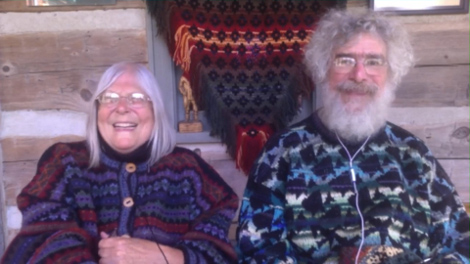
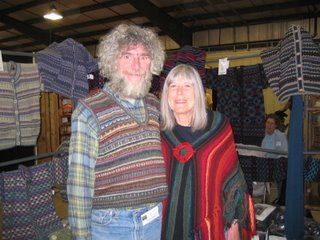
The late Eugene and Ann Bourgeois are in a special category of individuals who number among those unsung heroes and heroines living their lives through acts of love woven into their daily lives, as organically as were the threads of Eugene and Ann’s elegantly woven garments sold at their sheep farm, despite the tragedies that befell and altered their lives.

The larger world can be inspired in knowing the extraordinary qualities of these two individuals, and also their chosen way of life connected directly to the land and water, as examples to the rest of us how it is possible to rise above circumstances in which personal well-being and a thriving livelihood have been compromised by external forces.

Rather than succumb to justifiable personal and spiritual rage, Eugene and Ann not only chose to fight fiercely on behalf of the future well-being of the environment surrounding their homestead, for the other people living there, now and in the future. Equally important, they chose activities in their personal lives to bring joy, beauty and love into each day.

Eugene was scheduled to be an oral intervenor this past November, to raise questions – once more – about the safety measures of various nuclear industry activities, this time at an online public hearing about the decommissioning of the Douglas Point Waste Facility (DPWF). But, his life ended suddenly, possibly from a heart attack, in September, just a few months following the death of his beloved Ann. She had lost her final battle with cancer, which had afflicted her through many years, repeatedly pushed into remission through treatments.

The fact is, their beloved homestead already had been established in the vicinity of what became an ever growing Bruce Power site, said to be the largest nuclear power facility in the world today. Despite tenacious and repeated attempts in requesting studies by Bruce Power and the Canadian Nuclear Safety Commission (CNSC), to provide evidence that intermittent higher than normal atmospheric releases from Bruce Power – combined with potentially higher than presumably safe amounts of tritium in the well water – possibly caused the loss of large numbers of sheep and triggered Ann’s cancer, no evidence of unsafe levels could be verified.

My own research in recent years, however, has revealed that Bruce Power does not acknowledge `cumulative effects’ seriously enough and, moreover, I suggest that the CNSC measurement tools could have been inadequate. I state the latter based on reading an international report which declared that longstanding measurement tools used to determine levels of tritium had been discovered to be sorely inadequate to indicate actual harm to living organisms.

I initially met Eugene at the first of two public hearings in 2013 and 2014, both of us among local intervenors engaged in a relentless fight against the deep geological repository (DGR) for low-and-intermediate level radioactive waste, proposed for construction on the Bruce Power site near the shoreline of Lake Huron. (The proposal finally was terminated in early 2020 by a vote among members of the Saugeen Ojibway Nation – two sister Ojibway communities – a decision recognized by the DGR proponent Ontario Power Generation (OPG)).

Both Eugene and Ann were modest about their educational credentials. Ann had worked as a school teacher, and Eugene’s knowledge was grounded in university studies from mathematics to phenomenology. They designed their own humble yet beautiful homestead, which always was welcoming, and included one building delegated as their store to sell handmade woolen goods. Their multi-faceted business vision evolved , to include annual trips within and beyond North America, not just to sell their wares and exchange knowledge, yet also to develop a holistic business model in which all players could benefit more equitably.

My visits were always joyful, albeit occasional, given Ann’s increasingly frail physical health. Even so, she always was so gracious, embracing me in her inclusive warmth like a blanket. On one occasion, although we had met previously, Ann apologized (unnecessarily I might add) that she could not remember meeting me, explaining that the chemotherapy treatments altered her memory. In so many invisible ways, the cancer, treatments included, robbed her of so much that healthy people too often take for granted and fail to appreciate.

Nevertheless, her soulmate Eugene was a devoted caregiver and excellent cook. Their loving energy extended beyond each other to include their animals, their garden plants, and other people near and far. Each day was lived fully, with grace and generosity, endowed with the soulful pleasure of the gifts provided by the natural world that enveloped their homestead as well as in their personal daily routines, which included playfulness.

In other words, their capacity to experience joy was visible and contagious. No one can fake it. A person feels it, as I was blessed to witness and respect profoundly – and learn. Despite whatever life throws at us, we still can choose to be kind and contribute to humanity. They walked the talk of living in relationship, recognizing the sacredness of all life. Eugene and Ann experientially understood that the source of human well-being essentially includes the well-being of all planetary life.

Fortunately, their website The Philosopher’s Wool Company still exists, in which some links continue to work. My favourite link is Mother Bear Project. While the website Knit for the Homeless has disappeared, by typing those words, other links show up to encourage creative activities and/or information how to give donations to facilitate the distribution of knit goods. In another link, Eugene is one of the men featured in the Real Men Knit DVD.

I do hope that family members maintain this website, in a revised/updated version, so that the wider world continues to be inspired by Eugene and Ann’s example. The front page shows a poignant obituary by Eugene for his late wife Ann. Also worth reading is a 2010 case study of their business model identified on the front page, which you can click to open there. Noteworthy is the mention that illnesses in 2009 henceforth ended further travels to knitting shows, focusing sales to the farm shop and the internet.

In reference to the fight against the OPG DGR, plus related nuclear public hearings in Bruce County, government submissions deeply researched by Eugene Bourgeois are on public record in the online archives of both the Canadian Environmental Assessment Agency (CEAA) and the CNSC. More easily, if you google these two phrases together, in quotes as shown here: “Eugene Bourgeois” “nuclear waste,” you can access a selection of his submissions, and also various news interviews with Eugene.

By the way, a second website operated by Eugene, which focused on DGR issues, called Friends of Bruce, initially disappeared but has been uploaded. The reason is, the information remains valuable and timely. Another link related to Eugene is SOS Great Lakes, in which Eugene was a director. You can find some of his government submissions on its web page: sosgreatlakes.org/our-repository.

For the fight to protect the land and water continues, now focused against a second proposed DGR, this time to contain high level nuclear waste (spent fuel bundles), promoted by the Nuclear Waste Management Organization (NWMO) in two remaining Ontario communities, after several others previously pushed out the NWMO – one community on prime farmland in Bruce County, and the other community up north, where several First Nations hunt and fish. But those First Nations are not properly included in my opinion, despite the federal mandate to properly recognize the “duty of consent” of First Nations whose long-term well-being could be threatened by upcoming industrial projects.

See the front page of my website to look up the current grassroots organization leading this battle against the NWMO DGR in Bruce County, as well as to study related websites about the history behind the fight against DGRs proposed in Ontario.

My New Year’s wish is to inspire fellow human beings to care about what we all are bequeathing to future generations, by actions to protect the natural environment and preserve – as well as restore where necessary – a safer and healthier world worth living in. In my belief system, doing so is our highest spiritual purpose while we live on this Earth.

Happy New Year!!! Your caring will contribute to this possibility.

Posted in Uncategorized | Leave a comment

What is the Message from Notre Dame Cathedral’s Fire?

“To love is to act.” Victor Hugo, May 20, 1885

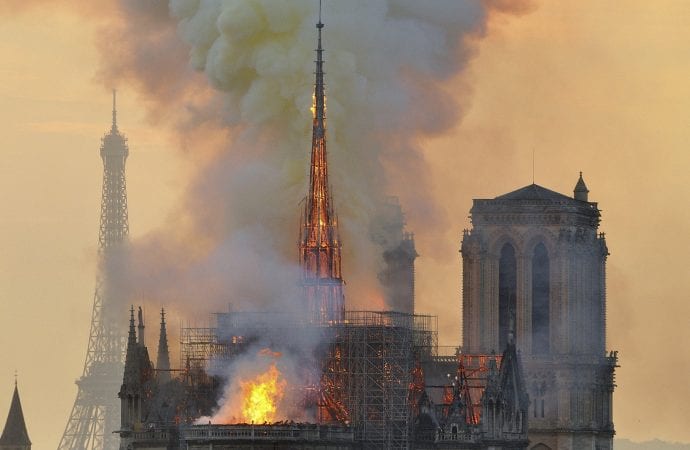
I will never know how many thousands of fellow human beings sat, riveted, to their respective television sets, radios or digital screens, gobsmacked and horrified by the sight of this 850-year-old spiritual edifice burning, at the onset of Holy Week. Through the initial crucial hours of the massive firefighting rescue, simply to witness the outpouring of hymns and prayers from the throngs gathered together at the site, nevertheless, was awesome.

The below photo was taken before the Cathedral’s spire fell, and also showing the Eiffel Tower in the distance to the left.UNESCO’s Director-General Audrey Azoulay communicated that the Notre Dame Cathedral in Paris is part of the World Heritage site “Paris, Banks of the Seine,” adding:

“Notre Dame represents a historically, architecturally, and spiritually, outstanding universal heritage. It is also a monument of literary heritage, a place that is unique in our collective imagination – heritage of the French but also of humanity as a whole. This drama reminds us of the power of heritage to connect us to one another. We are receiving messages of support from all over the world.”

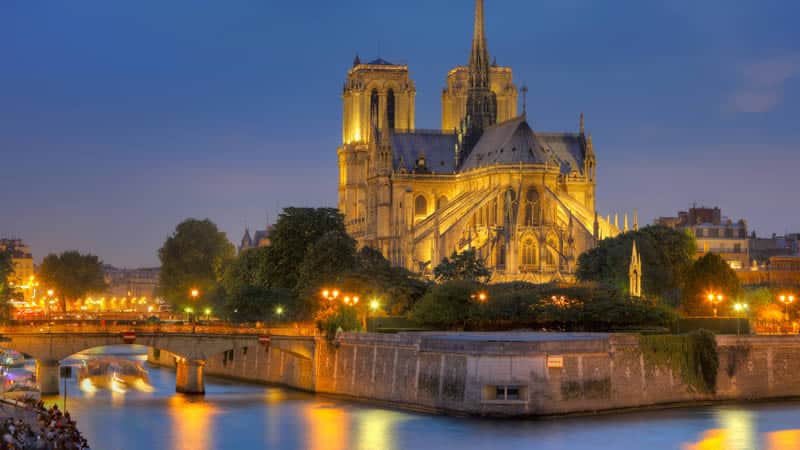
The below image shows the Cathedral from a different side, in its former night-time glory, within a fuller Seine River setting, along which even the stone embankments are protected as part of this whole UNESCO World Heritage site.

Regardless of our religious faith, or even lack thereof, the 2019 Holy Week fire at the Notre Dame Cathedral in Paris awakened within people around the world our shared higher qualities, which reside within us, energetically, at a soul level.

For the first time in recent years, I honestly consider the fire not in and of itself, but rather in relation with the widespread human response, to be a harbinger of hope for the human family. When something triggers the connection with our soul, we respond with love. We are here to learn how to take care of each other, which includes taking care of the sacred edifices across human cultures which were constructed to remind us about our interrelationships here, as well as those which reach beyond our earthly existence to a spiritual realm.

To me the hope for human survival on earth resides in our recognition of what we hold in common. The burning of this Notre Dame Cathedral provoked the hearkening of the human soul which spontaneously unites us at this deepest level of our being.

The soul is much more powerful than either our rational mind or our emotions, the latter ways of knowing representing only fragmented aspects of our fuller consciousness. When the soul awakens, all of our inner ways of knowing are activated to respond, to open us to the larger dimensions of our existence beyond individualized personalities and egos.

In other words, in what has become an increasingly secularized world – and, worse, the original spiritual teachings distorted and perverted by fundamentalists and extremists – crises appear to be the essential events to call upon us to act from our innate higher qualities, such as love, compassion, generosity, grace, gratitude, humility, forgiveness and more, which open us to the deeper meaning of being alive.

Woven throughout human history are crises that provoke actions grounded in love.

The Notre Dame Cathedral in Paris embodies many layers of meaning, one of which is its resilience to survive, even prevail, through periods of turbulence a number of previous times, because people cared deeply enough to restore, repeatedly, what was damaged.

Given the major damage to this Cathedral, for example, inflicted by the violence of the French Revolution, the Cathedral was under threat to be demolished. But, Victor Hugo, whose political life and literary works were based upon love and justice, felt compelled to challenge this threat of demolition through his story of The Hunchback of Notre Dame. Who could know how timeless, and universally loved, this poignant story would become?

Hugo’s vision, however, was more immediate, to save the Cathedral from demolition. The Culture Trip website contributor Jade Cuttle in 2018 elaborates in her own words selected brief citations from Hugo’s famous book:

“The descriptive sections of the book are so extended, going far beyond the requirements for the story, that his conservation efforts are clear. `There exists in this era, for thoughts written in stone, a privilege absolutely comparable to our current freedom of the press. It is the freedom of architecture,’ he wrote in praise of its construction.”

Cuttle also writes, in reference to Hugo’s use of metaphor in his book’s message:

“The bell-ringing, half-blind hunchback of Quasimodo has become iconic of `a courageous heart beneath a grotesque exterior.’ This character urges readers to look beyond the surface and find the beauty beneath, with the hope that they’ll do the same for Notre Dame.”

Storytelling is unique to the human species, as is the language of metaphor. I always recall the words of the late Indigenous spiritual elder Art Solomon, who pointed out that humans are the only species on earth who need stories, to remind us of our purpose here, because we forgot the `original instructions’ from the Great Spirit for us to take care of the earth.

In fact, sacred structures in every human culture embody multiple layers of symbolic imagery to communicate stories, that evoke the connecting threads of our history through time and, importantly, what we hold in common as a human family.

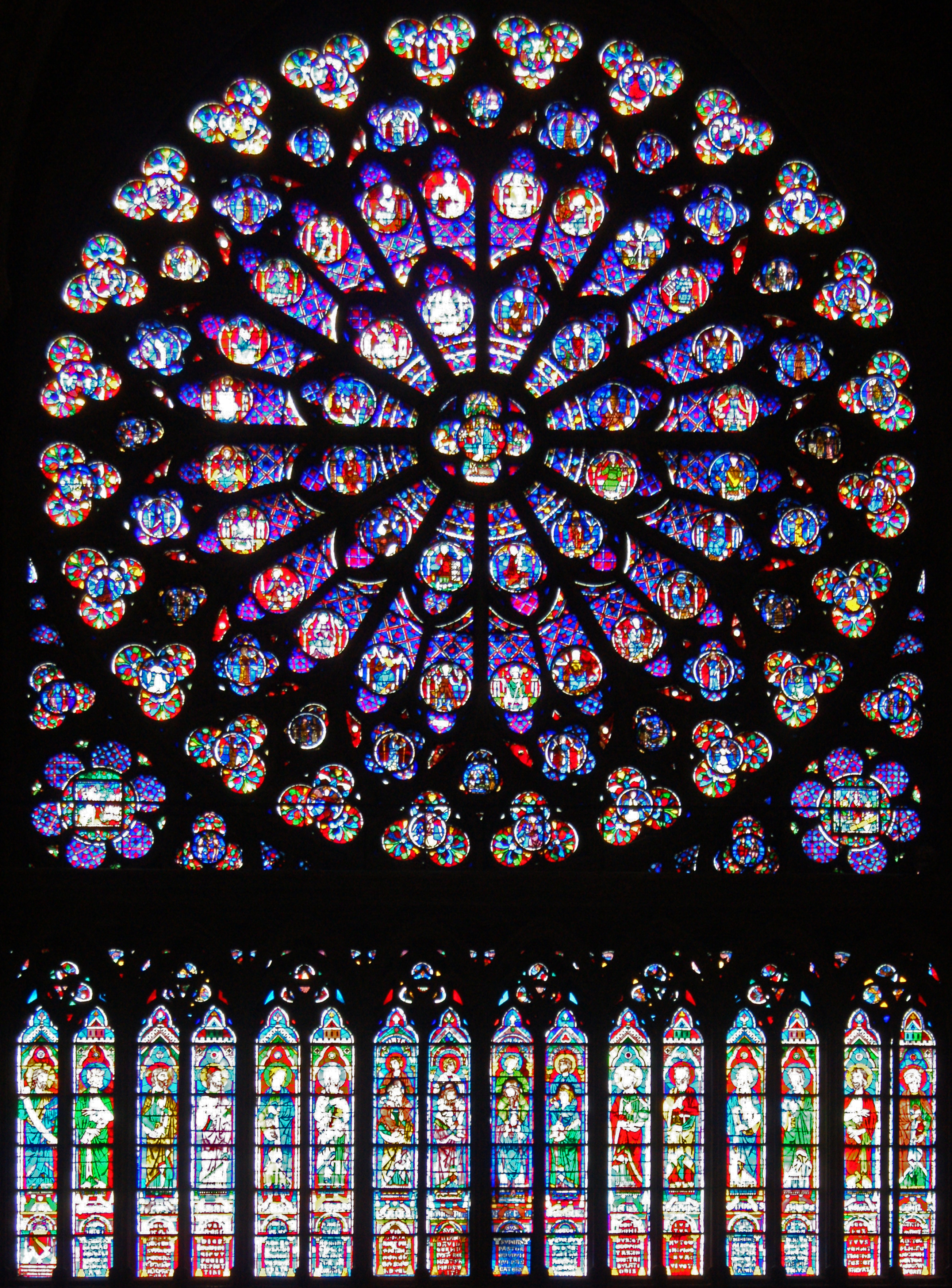
When Hugo referred to “thoughts written in stone,” such thoughts as well as feelings are embodied not only in the stone structures which include, of course, numerous carvings of both biblical and mythical beings. Yet, as well, the Cathedral is filled with sculptures, paintings, finely-crafted religious ornaments and, last but not least, the magnificent stained glass windows – all of which relate stories.

As a young adult attending art college, I majored in stained glass. We students used antique glass imported from Europe. Other traditional components included lead and cement. We executed the delicate, and painstaking, procedures of glass cutting to shape each and every piece of glass before interlocking the multiple pieces, one at a time, within lengths of lead (initially stretched) bent gently and firmly around each piece of glass, all of which then were cemented in securely. Creating even a modestly sized single stained glass panel took months of physical labour.

Powerful memories stay with me, regarding the intense labour yet, ultimately, the heightened sense of glorious accomplishment to create an art work so beautiful and lasting. The changing light each day, indeed, in accordance with different times of day, different seasons and weather, render stained glass continuously new and sensually alive.

Therefore, upon witnessing the Notre Dame fire, what struck me was the immensity of what was happening, and the potential to destroy and lose in a matter of hours what took more than two centuries to construct originally – through the labour of thousands of people, inspired by a spiritual force larger than themselves, to apply their highest art and engineering talents, in a collective pursuit to create something of extraordinary magnificence and timelessness that would far surpass their own life spans.

To sum up, what the Cathedral’s structure and its many artefacts embody represent something far beyond the visible physical appearance. Consider, as well, how the physical structure of stone and wood originated from materials in the natural environment. In other words, the feeling of sanctuary in the building touches us invisibly as well, through connecting us energetically with the earth as well as with Spirit.

So what is the message in the Notre Dame Cathedral in Paris fire? Actually, there can be several messages, depending on whether we take time to reflect upon how and why the fire affected each of us in particular ways. Even not feeling personally affected could give pause to reflect on why as well.

Why do we exist? Life’s journey can bestow joy, beauty, love, as well as inner and outer peace. Their deeper appreciation and experience, however, cannot be bought, nor do they come easily or quickly. Instead, they require conscious effort to deepen our awareness, earned through time as we learn to pay closer attention to what really matters.

Technology, for example, always has been with us. Indeed, communication through digital tools immediately informed people across the world about this fire. They, in turn, could choose to respond – and did, in huge numbers – to share their sorrow, bewilderment and also support, through spontaneously awakened hearts and souls. We all hold that possibility in common.

How we choose to use digital technologies, even so, is one of the challenges of our time.

We have arrived at a historic moment when so much information and knowledge is at our finger tips. But, how wisely are we using our intelligence – for those of us who have the privilege of access to digital tools – to consciously make the extra efforts to deepen and broaden our awareness in the pursuit of healing and restoration, through the choices we make using these tools?

Deepening and broadening our awareness, in fact, requires knowing when not to be using digital technologies. Instead, when do we give ourselves the gift of being fully present to our immediate external environment and the people with whom we are experiencing it, sometimes together with animal companions as well?

Personally, I feel blessed residing on a countryside homestead where, even while working at my computer (technology), I can look out the window – when I am not outdoors directly experiencing nature – to enjoy serendipitous visits from various animals, birds and insects among the bushes and trees in all seasons. When immersed outdoors, all aspects of my being – physically, emotionally, intellectually, and spiritually – open to the wonders of nature and the universe, as I gaze upon the woods and open fields, and also the vastness of the starlit sky. Such experiences awaken my whole body as well as my heart and soul to cherish, and protect, the beauty around me.

Similarly, spiritual sanctuaries such as cathedrals have been created to awaken our innate qualities holistically, that reconnect us to what really matters – our interrelationship with Creation, within and beyond our earthly realm, and our highest calling, to take care of all planetary life.

Always we have free will to choose where we place our attention. Always possible is holding in our hearts such words of wisdom as Victor Hugo’s: “To love is to act.”

Choose, therefore, not to be bombarded continuously by what is divisive, hurtful, misguided and focused on the turmoil in the world. Instead, choose where you can gain knowledge and experience, that can develop your capacities to take actions that protect, restore, and strengthen love and justice wherever you live and travel.

Yet also take time to reside in natural settings and in human-created sanctuaries, to replenish your energy, experience serenity, and awaken to the wonder and joy simply in being alive.

Posted in Uncategorized | 1 Comment

Why Cultural Appropriation Is Morally Wrong

                                             “To be equal, this is what I like.” Norval Morrisseau
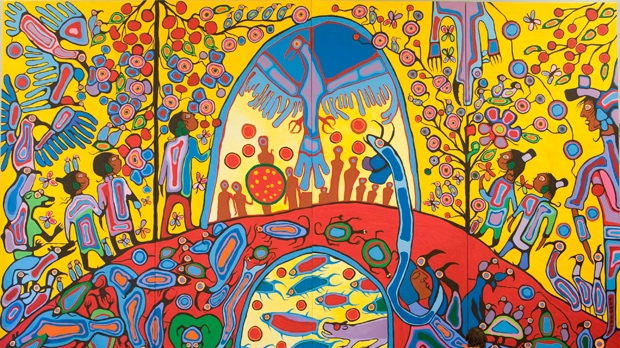
blogimage2These simple words speak volumes, in Norval Morrisseau’s closing statement to CBC-TV’s Close Up reporter June Callwood, on the occasion of Morrisseau’s 1962 first art exhibition, at age 31. His remark followed upon Callwood’s acknowledgment that his 35 paintings had earned him $4,000, and how did he feel about it. Morrisseau, introduced as shy and mystical by a male CBC-TV newscaster, had mentioned to Callwood his childhood dilemma, to negotiate a Catholic upbringing with traditional Ojibwa spiritual beliefs and, more specifically, his personal spiritual experiences during walks in the woods. The whole conversation is poignant, given Morrisseau’s trust that his deeply felt spirituality would be understood.

Unbeknownst to Callwood, who asked simple questions with courtesy, Morrisseau’s life, henceforth, would continue to be fraught with conflict between his inner spiritual experiences vis à vis producing works of art that foregrounded sacred imagery for a Euro-western clientele who were attracted to imagery so unique, and mysterious, to them. Moreover, the lifelong struggle for Morrisseau to survive psychologically in a secular Euro-western culture predominantly based upon materialism – success valued by financial measure – would be unimaginable.
image

Twenty years later, in 1982, I had begun to write about Aboriginal issues, as a newly minted journalist. My motivation was grounded both in unsatisfactory B.A. university studies in which “Native peoples” were treated as historic versus my real life encounters soon afterward in 1979, in Kenora, Ontario, with living contemporary Ojibwa and Metis individuals. The revelation for me was that Native people still existed, not merely as individuals yet, more importantly, as nations, for Canadian government and citizens to deal with and recognize. Those encounters changed the direction of my life, and I began reporting on the first peoples of Canada, whom I never had learned about throughout my formal years of education. Within a decade, I became disillusioned as a journalist, awakened not only to the cultural racism in all Western institutions yet also, with dismay, even within the news media itself.

I cannot recall how many of my stories about Aboriginal achievers were rejected by mainstream media, but instead were welcomed by then-existing Native newspapers and magazines across Canada and in the United States. Canada’s federal government subsequently terminated funding to most indigenous news publications across Canada, making it impossible for small Aboriginal nations to inform their respective peoples effectively on events pertinent to their lives. To be true to the culturally restorative mandate of the `truth and reconciliation’ initiative, I advocate that the federal government ought to provide Indigenous journalism funding again, more inclusively across the country.

In those early years, only a few Aboriginal journalists worked in mainstream media. Among them, outstanding Mohawk reporters Brian Maracle and Dan David did their best to endure the undercurrent of systemic racism in various newsrooms to produce important stories. They followed upon the new wave of Native political activism that began in the 1960s. edesk
My film Soop on Wheels relates the life of one of the earliest among those pioneers, the late (still under-recognized) Blackfoot political cartoonist Everett Soop. The larger cultural movement, initiated by artists, spread throughout North America, planting the seeds for the American Indian Movement (AIM) in the USA, while Aboriginal political organizations developed in Canada.

Fast forward to the 1990s. I was pursuing two graduate degrees back-to-back at the Ontario Studies for Education at the University of Toronto (OISE/UT). As a member of a cross-cultural Indigenous committee advocating for Aboriginal courses of study, I recall a debate that truly shocked me. A few of the Aboriginal students questioned a Morrisseau painting (hanging in a hall way) in regard to its authenticity as Aboriginal art. By then, a freelance journalist through many years and art college graduate who initially wrote about Aboriginal artists, I was well-informed about Morrisseau, and gobsmacked that his work would not be well-known to everyone. What this debate signified, however, was how profoundly younger Indigenous people had been separated from their cultural heritage, to the degree that they were oblivious to their own artistic pioneers in the Indigenous cultural revival.

For all of the above reasons – the Indigenous cultural, and personal, spiritual roots of Morrisseau’s art; the life-affirming intention by him to share with the wider world the sacred meanings in his work; the pivotal role of his Indigenous art in the early years of Indigenous cultural revival; and the obvious continuing challenges for Indigenous people to be able to recognize and take pride in the creatively-gifted expressions by their own people – I stand totally against the current non-Indigenous painter, a young woman named Amanda PL, who demonstrated the most powerful example of wrongdoing in her appropriation of the Woodland style of art initiated by Morrisseau.

Amanda PL has no business “to make it my own,” as she is quoted saying in an online CBC article, one of a series published on cultural appropriation in recent days. These images are not her own, and never can be. Their origin is too specifically recognizable as referents not only to a different culture, yet more personally to the medicine dreams (mentioned by Morrisseau to Callwood) of another human being. Her stubborn willfulness to continue, despite an art gallery cancelling her show, illustrates the failure of mainstream society to instill awareness about, and respect in, our Indigenous history and also honour what are distinctly Indigenous contributions to deepen human understanding across cultures.

Fuller human understanding embraces the yin-yang of unity in diversity. Authentic honouring of unity in diversity is to know how to distinguish what we hold in common as a human family in relation with what each human culture contributes uniquely through its own distinct expressions of universal spiritual experience and belief, and more. As an African woman states in the excellent documentary The Destruction of Memory: “Cultural heritage is the mirror of humanity.”

I would add that the highest purpose of cultural productions importantly facilitates a continuity with our past, to remind us what is valuable to retain in regard to our origins, to awaken us to what was forfeited and needs to be recovered, as well as to recall transgressions that need amending – ultimately for our consciousness to evolve and transcend the false, human-constructed `us/them’ dichotomy. We need to appreciate why we are here on earth, through the practice of our shared higher spiritual qualities. Those qualities are manifested not only in physical artifacts such as sacred structures and ceremonial items for worship yet, moreover, kept alive through all forms of storytelling.

I have deeply appreciated the clarity of communications in recent days, on CBC television and in online CBC articles, from Jesse Wente at CBC, Trevor Greyeyes as publisher of First Nations Voice, and Niigaan Sinclair as an author and acting head of Native Studies at the University of Manitoba. Please look at the video interview with Jesse Wente on CBC radio’s Metro Morning, as well as CBC The National‘s segment “Why an editorial sparked a cultural appropriation storm.” These news items eloquently cover the concerns about `cultural appropriation,’ and point out why this issue is distinct from infringing on `freedom of expression.’ Note how these Indigenous spokespeople emphasize that production of stories about Indigenous people is different from taking ownership of Indigenous voices, even though the former is not above critique as well.

Nor should any cultural production be above critique. As a disillusioned journalist, I became involved in media literacy – an international educational movement that began in Australia, spread next to the United Kingdom, followed by Canada and the USA, some European countries and, finally, some nation states on other continents. From the late 1980s, I specialized in investigating the 500-year `back story’ to stereotypes and cultural racism, related in the pattern of misrepresenting Indigenous people in Euro-western imagery. I conducted many workshops around North America at conferences for teachers, conflict resolution professionals, and fellow journalists.

In those years, through the 1980s and early 1990s, I also attended Indigenous conferences regularly – it was an exciting time – to listen and learn about the concerns voiced by a number of traditional Indigenous people who, since then, have crossed over to the spirit world. One of the constant themes, underpinning the need for cultural revival, was the profound inter-generational spiritual devastation, hence cultural destruction, from the demonizing of Indigenous spirituality and outlawing of it. Spirituality had been at the core of Indigenous life. For example, particular rituals enabled each person to be valued and to become aware of their responsibilities, in order to feel a place of belonging in the communal embrace of the community.

In fact, I would suggest that the issue of cultural appropriation is caused by the continuing lack of wider public awareness – and continuing systemic denial about – the long history of systemically-grounded racism. It is shameful that this history is not yet a mandatory part of school curriculum, no longer merely relegated to a single course in one grade level. Instead, various curriculum subjects could incorporate not simply the political, economic and religious wrongs but, importantly, also include insights about the resilient strengths of Indigenous people and their contributions, that more completely have shaped Canada’s world identity.

As a non-Indigenous person, my perspective is that the systemic loss in my own Euro-western culture of what I consider to be a fundamental spiritual truth – that all human beings are spiritual beings in physical bodies during our earthly existence – is why Euro-western culture through centuries wreaked so much destruction upon cultures different from its own. In other words, European ancestors, collectively speaking, long ago had severed our understanding of the basic reality about human interrelationship with Spirit and with Nature. Today the same destruction continues through industrial projects that undermine the planet’s life support system, such projects fed by gross consumerism reinforced by capitalism. We all are implicit, by our very human existence, in the fate of the world environmentally. Today we are called, across the human family, to strive towards a transformation of human consciousness. To me, that shift is essential to turn around the trajectory of global environmental destruction.

My above characterization of the human condition is the very big picture wrapped around the need for serious change at multiple levels. Such change, therefore, is not limited to a meaningless litany of continuing apologies from those who are privileged and power-holders across all societal sectors. Not only do Indigenous people deserve more, but so does the human family and all planetary life.

In Canada, `truth and reconciliation’ is not simply a template of policy. More importantly, it is a guide to provide a pathway for people across cultures to pursue some genuine exploration to understand where Euro-western culture and its institutions went wrong, leading to such extraordinary, inter-generational harm inflicted upon Indigenous people, the amends long overdue. Amends can begin through individual acts of respect – such as avoiding cultural appropriation – plus essential transformation at Western institutional levels.

Euro-western society sorely needs to address its own systemic flaws perpetuated in institutions that tragically exhibit mainstream culture’s fragmented consciousness – the split from Spirit and Nature. Doing so is an essential pursuit and non-Indigenous responsibility, on top of our role in cross-cultural healing, to strive together with Indigenous people (and the larger human family) to protect and restore a threatened planetary life support system. The pursuit of healing the natural environment is one type of multi-faceted, collaborative, and life-affirming action among other possibilities, along the path of reconciliation.

Returning to the issue of cultural appropriation per se, Hal Niedzviecki’s opinion piece in Write magazine that opened with his assertion, “I don’t believe in cultural appropriation,” followed by him advocating a prize for non-Indigenous writers to exploit it, exposed the depth of societal lack of awareness about Canada’s history – more painfully evident when some high profile “white” writers then agreed to contribute money to such a prize. The entire sorry farce exposes the continuing hurtful consequences caused by ignorance when well-known and respected cultural producers behave so insensitively. The reason is, their tacit agreement (whether in jest is irrelevant as a stupid excuse) – as privileged professionals – gives permission for the larger public to behave similarly.

With that said, this firestorm is only the latest in an identity politics movement that arose with a vengeance – cultural appropriation in the eye of the storm – more than 20 years ago, in universities and across Canada’s literary terrain. I got caught in the cross hairs of it, and witnessed the dark side of identity politics when it is used and abused as a tool for censorship and, worse, an ugly method to alienate the allies who are culturally respectful. Allies are essential as bridge-builders to enhance healing across cultures. Today we need a lot more cross-cultural dialogues with related community-based actions, from talking circles to public panels, in order to facilitate the essential change that is needed for genuine reconciliation to happen. In other words, all cultures need to be better aware of history through the lenses of different cultural perspectives, to build together a bridge to mutual understanding.

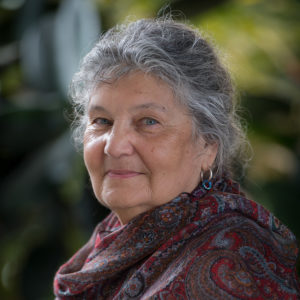
I recall with a wry smile Maria Campbell’s wordsMaria-Campbell-picture-300x300 to me, during a long afternoon conversation many years ago, part of which was an interview with her for a profile in a Native American magazine. Maria, a Metis writer, filmmaker, broadcaster, and much more, stands among the pioneering Indigenous contemporary storytellers, who spoke her truth powerfully. Today, she herself would be valued as an elder. In her no-nonsense style, she told me that when you get everyone mad, you probably are doing something right.
Sure enough, I eventually experienced being attacked by individuals from every side, but mostly within my own culture. Seeing Jesse Wente’s emotional commentary on Metro Morning, in which he said that he hopes never again to experience the display of insulting responses to the issue of cultural appropriation, deeply resonated with me, in accordance with an incident in my life 20 years ago. I had an experience, in a `cultural studies’ course at OISE/UT, which I wished never to be repeated. After an attack that descended from intellectual to personal, I ended up bedridden for the next two days, my body in a major spasm. I swore never again would I give away my inner power to external attackers, enabling them to silence me.

The assignment given me by a professor was to analyze an essay by an Ojibwa woman, as part of my oral class presentation to challenge the discrimination against Indigenous spirituality, within the larger issue of cultural racism in my society. I began by pointing out that the Ojibwa woman, who named the fact that she had not been raised within her own culture, had “intellectualized Native spirituality” in the way that she criticized the “alleged” events during her participation in a Native ritual. In that classroom, no Indigenous student was present. However, a vocal number of the students held Marxist views, so that discussion of anything spiritual, for starters, was fuel for attack. Among the litany of insults that followed, someone said that Native people only accepted me because they were being polite. That statement, to me, was an insult to the integrity of the many Native people whom I had encountered. Before the tears silently fell, and I still had a voice, I did point out that I never yet have met a Native person too polite to express displeasure directly to any individual, privately or publicly.

I never was shy about challenging appropriation. During a visit to the Maritimes, I triggered haughty anger from a Celtic artist who worked in porcelain. He told me about his intention to start using Indigenous imagery, and I tried to explain why he ought to rethink doing so. Even based on simple economics, it always has been difficult enough for any artist to earn income. Secondly, consider the pleasure by the buyer, who purchases a work of art directly from its creator, and can receive the layered story behind its meaning. For Indigenous artists particularly, the layers reside in the fuller cultural history, with acts of cultural revival, as well as personal healing and celebration, signified in the production of genuinely meaningful artistic expressions.

Several times I have been verbally lambasted when I criticized the exploitation of Indigenous spirituality and, worse, the misrepresentation of it, in fictional works. A foremost example was in reference to the `Medicine Woman’ book series authored by Lynn Andrews, in which a “white woman” appears to be the ubiquitous heroine through exploiting Indigenous spiritual concepts and practices while, moreover, mixing them up from diverse tribal nation sources.

What Andrews exploited through the later decades of the twentieth century was the spiritual hunger felt within Western culture, most particularly in North America. Even the Austrian psychiatrist Viktor E. Frankl, a survivor of the Nazi death camps who relocated to the United States, referred to the “existential vacuum” existing here. I also recall the words of Tuscarora scholar Richard Hill, in the 1980s, who applied the label “shake-and-bake-shamans” to those individuals within Indigenous cultures who similarly exploited the spiritual quest of any and all seekers, primarily for personal financial profit.

The trajectory in the Westernized treatments of Indigenous spirituality, therefore, began in missionaries demonizing and desecrating it, followed by political outlawing of symbolic, and actual, presentations of traditional practices – together with forbidding Indigenous languages in the schools – to rampant commercial exploitation in the late twentieth century. No wonder Indigenous people get really pissed off!

When the outlawing began, threatened Indigenous cultural practices went underground to be protected. The integrity of some ceremonial practices survived and, in accordance with traditional teachings, certain ceremonies were opened to cross-cultural participation. This was done to broaden the understanding across cultures about human interconnectedness not just among each other yet, very importantly, with all planetary life. Indeed, renewing cross-cultural dialogues and actions today about our imperilled planet could be one of the most promising and productive paths for reconciliation, at many levels.

I clearly remember the profound concern about running out of time expressed among my generation of Indigenous storytellers trying to gather and preserve traditional knowledge from the elders who had lived it, before they were all gone. Moreover, they agonized over the discernment required about how to communicate cultural traditions vis à vis the need to earn a modest living in today’s world, most particularly when communicating their own spiritual knowledge across cultures. Sharing it, nevertheless, was part of the intention as well in traditional storytelling. For example, teaching basic morality in how to conduct ourselves in this world.

The latest twist, most egregious in the educational sector, is that the works of creators ought to be available to students for free. Once again, respect still is not understood within Euro-western institutions to appreciate the arts in their higher purpose. Even as `callings’ for some practitioners, in today’s world, necessarily, they also ought to be recognized as professions, in which the ability to earn a livelihood increasingly is undermined by violations of copyright. What is overlooked is the reality that serious messengers, dedicated to gathering and disseminating knowledge, want to do so through a lifelong commitment of ongoing deep research, in a professional capacity. But, in today’s reductionist, and dumbed down mainstream, cultural climate, who will be the younger generations of such committed storytellers and messengers? As well, who will demonstrate more respect for the veteran storytellers, across cultures, before we are gone?

Indeed, across cultures through the ages, the memorable artists always have been on the cutting edge, yet sadly either overlooked or controversial in their own time. In every historic era, they have illuminated, through storytelling in various arts (writing, painting, music and theatrical performance): the perennial human condition in particular places at particular moments; who we are (or assume we are) in our human diversity; what are our responsibilities; what befalls us when we abdicate moral responsibility; and what is possible, if we have the will to strive consciously towards it.

My late Blackfoot friend Everett Soop gave me strict instructions not to present him either as a victim or as a role model in his life story Soop on Wheels. Everett wanted simply to speak his truth, and be seen as a whole person even as he presented his human imperfections, with integrity and courage. One film segment shows Everett encouraging Indigenous students to speak out for their people. He believed the power of self-determination resided in the heart and mind of each individual. Everett would be so proud of today’s growing numbers of Indigenous professionals, who are using all forms of creative media to be silenced no more.

POSTSCRIPT: Morrisseau’s painting `Androgyny’ exhibited in Rideau Hall, Ottawa, and photographed  in 2008 by Adrian Wyld, THE CANADIAN PRESS

Posted in Uncategorized | 2 Comments